Global Medical Brigades (GMB): The Best International Clinical Opportunity for Premeds
Learn why GMB is the gold standard for gaining clinical hours abroad, navigating healthcare systems with cultural humility, and bypassing the voluntourism trap.

You can translate GMB’s global health experience into med school acceptances.

What You'll Learn
Global Medical Brigades Program Overview
How Global Medical Brigades operates as a student-led organization connecting volunteers with international health initiatives.
Ethics and Impact of Voluntourism
Critical considerations around sustainable community support, cultural humility, and avoiding harmful practices in international medical trips.
Scope of Volunteer Responsibilities
Clear boundaries defining what pre-med students can and cannot perform during brigades to ensure patient safety and ethical care.
Evaluating Admissions Value
How medical school admissions committees perceive international volunteer work compared to local, long-term clinical experiences.
Financial and Time Commitments
Considerations regarding participation fees, travel costs, fundraising strategies, and time investments for volunteers.
Maximizing Application Impact
Strategies for framing brigade experiences authentically in personal statements, secondary essays, and interviews without sounding transactional.
Alternative Clinical Opportunities
Local and domestic alternatives to international brigades that provide consistent, impactful clinical exposure and community service.
What is Global Medical Brigades? History, mission, and global footprint
The core philosophy: Why GMB is "adcom-proof"
What the experience is actually like: Firsthand insights from Panama
How to get involved: Selecting your path
How to leverage GMB on your medical school application
Frequently asked questions about Global Medical Brigades
The current landscape of clinical exposure in the US and (especially) Canada is not friendly to you as an applicant.
Not only are clinical experiences difficult to secure, but even if you do manage to find a shadowing or volunteering position, you often find yourself stuck at the back of a clinic room, watching a physician type into an electronic health record for hours on end. You’re logging hours, but are you actually learning what it means to care for patients?
When you look for clinical opportunities abroad, you encounter a different obstacle: the voluntourism trap. Medical school admissions committees are incredibly skeptical of international trips where untrained undergraduates fly into a resource-limited community, shadow a doctor for a week, hand out generic medications, take a few photos, and fly home. To an adcom, this looks like privilege, not a genuine commitment to medicine. It raises serious ethical questions about patient safety and community exploitation.
So, how do you cross this bridge? How do you get high-level clinical exposure that teaches you the realities of healthcare while demonstrating to admissions committees that you understand medical ethics, cultural humility, and public health systems?
The answer lies in finding an experience that is built on long-term infrastructure rather than short-term charity. Global Medical Brigades (GMB) stands out as an option that addresses both student needs and institutional ethics.
This guide breaks down everything you need to know about GMB—from its structure to exactly how you can translate your on-the-ground experiences into an application that resonates with top-tier medical schools. By the end, I’m confident that you’ll understand why GMB is my top recommendation for international clinical experiences.
Want expert guidance on medical school admissions?
Enter your name and email for weekly advice, plus our free 102-page guide to help you with every step: Get Into Medical School: 6 Practical Lessons to Stand Out and Earn Your White Coat
----
What is Global Medical Brigades? History, mission, and global footprint
To understand why adcoms view Global Medical Brigades differently than a standard "volunteer trip," you have to look at how the organization is built. GMB isn’t a travel agency that packages volunteer experiences; it’s a long-standing, student-led international development and global health organization.
The 20+ year history of sustainability
For more than 20 years, GMB has worked to implement a structured, systems-based approach to international healthcare delivery. Rather than treating communities as passive recipients of aid, GMB operates on a model of sustainable development and community empowerment. The organization was founded on the premise that health tracking and medical care should not disappear when a group of international volunteers boards a plane home.
Over two decades, this model has evolved into a highly integrated network of local staff, international students, and community leaders who maintain a continuous presence in the regions they serve.
The global footprint: Where GMB operates
GMB embeds its programs deeply within specific regions to build long-term data tracking and community trust. Currently, GMB supports structured healthcare delivery and public health infrastructure across three primary regions:
Central America: Highly established networks working with rural and under-resourced communities in Belize, Guatemala, Honduras, and Panama.
West Africa: Programs in Ghana focused on expanding rural healthcare access, patient education, and sustainable sanitation infrastructure.
Southern Europe: A unique global health initiative that specifically addresses the complex healthcare access needs of migrant and refugee communities in Athens, Greece.
By focusing on these specific locations, GMB ensures that its presence is part of a continuous, year-round cycle of care managed by local leadership.
----
The core philosophy: Why GMB is "adcom-proof"
When evaluating any clinical work you did abroad, an admissions committee will look for specific warning signs of an unethical program. If your experience consists of a one-time, "in-and-out" mobile clinic with zero follow-up, your application will likely trigger those warnings.
GMB is structured to avoid these pitfalls through three foundational pillars:
1. The Student-led, locally positioned model
While GMB chapters are organized and led by students on university campuses, the execution of the programs on the ground is completely integrated with local healthcare professionals and in-country teams.
You are not going abroad to direct a clinic; you are going to work alongside local physicians, dentists, pharmacists, and public health engineers who understand the community’s longitudinal needs. This structural humility is exactly what adcoms want to see.
2. Systems-based practice vs. isolated charity
A major critique of traditional volunteering is that it ignores the systemic root causes of disease. GMB avoids this by taking a systems-based approach to global health.
When a brigade enters a community, it doesn’t just set up a temporary examination table. It plugs into a larger ecosystem that addresses the social determinants of health: clean water access, economic development, public health education, and sustainable sanitation infrastructure. You learn to view medicine not just as a series of isolated diagnostic decisions, but as a discipline deeply intertwined with infrastructure, policy, and resource distribution.
3. Year-round sustainability
The single most important distinction between an ethical global health experience and voluntourism is what happens when the volunteers leave.
| In-and-Out Clinics: Volunteers show up, distribute acute medications, and leave no records behind. | Year-Round Continuity: Mobile clinics and care networks operate continuously under permanent local leadership. |
| Isolation: Medical care is separated from clean water, sanitation, and economic realities. | Intersectionality: Direct link between clinical care, public health infrastructure, and patient education. |
| Paternalism: Foreign volunteers make decisions about what the community needs. | Community Empowerment: Programs are entirely community-driven and tailored to long-term regional health goals. |
Because GMB's programs run year-round under local medical direction, your participation directly supports an ongoing, permanent healthcare system. The data collected during your brigade is used by local doctors to track chronic conditions like hypertension, diabetes, and parasitic infections over months and years.
----
What the experience is actually like: Firsthand insights from Panama
To give you an authentic sense of what this looks like on the ground, let's examine the operational reality of GMB's programs, drawing directly from my recent site visit to medical, dental, and public health brigades in Panama.
When you step into a GMB community, you’re immediately integrated into a multi-disciplinary healthcare ecosystem. This isn't a passive observation exercise; it’s an active, collaborative environment where you are expected to roll up your sleeves and work across several specialized stations.
Medical and pharmaceutical stations
In the medical brigades, you work directly with local physicians to assist in the operation of mobile clinics. You assist with patient intake, shadow the diagnostic and clinical decision-making process, and observe how physicians navigate language barriers and resource constraints to deliver high-quality care.
In the pharmacy station, under the strict supervision of licensed in-country pharmacists, you assist in packaging and distributing prescribed medications while learning about local pharmacological challenges and patient compliance strategies.
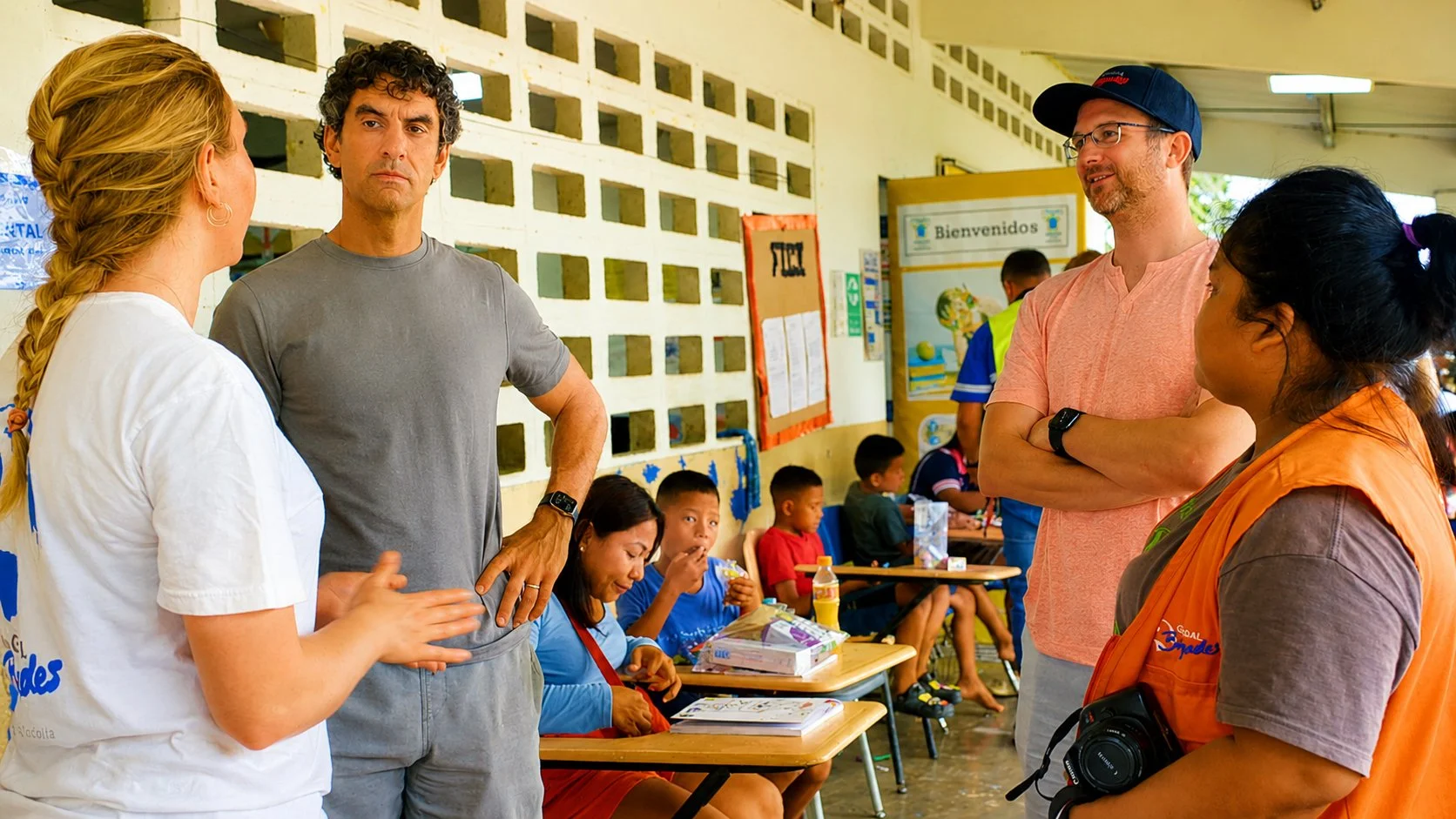
Dr. Shemmassian visits a Global Medical Brigades operation in Panama
Dental brigades
If you’re interested in systemic oral health, the dental brigades offer a rare immersion for undergraduates. You assist local dentists as they perform preventative screenings, extractions, and restorative procedures, while gaining an understanding of how oral health correlates directly with systemic conditions like cardiovascular health and nutritional stability.
Public health and sanitation brigades
Perhaps the most eye-opening component of the experience is the direct connection to public health engineering. You don't just stay inside the clinic walls. In Panama, I observed students participating directly in clean water access initiatives and public health sanitation projects.
This means physically working alongside community members to construct clean-burning eco-stoves to prevent chronic respiratory illness, building sanitary latrines to eradicate waterborne parasites, and installing clean water concrete flooring.
----
How to get involved: Selecting your path
GMB offers flexibility in how you choose to engage with their work, allowing you to tailor your involvement based on your academic calendar and leadership goals. There are two primary avenues for participation:
1. Joining an upcoming brigade
You can join a structured brigade during standard academic breaks. These programs are designed to optimize your time on the ground, typically yielding up to 50 high-quality clinical and public health hours.
During this intensive period, you’re fully immersed in the daily clinical operations, community health education workshops, and infrastructure development projects described above.
2. Stepping into campus leadership
If you want to maximize the impact of this experience on your medical school candidacy, you should consider stepping into a student leadership role within a GMB chapter on your campus. If your university doesn’t currently have an active chapter, you can take the initiative to found one.
Leading a chapter involves coordinating logistics, organizing recruitment campaigns, managing budgets, and preparing your peers through pre-brigade ethical training and cultural preparation. This long-term commitment demonstrates institutional leadership, organizational capacity, and a sustained dedication to global health equity—qualities that are highly valued by adcoms.
----
How to leverage GMB on your medical school application
Gaining the experience is only half the battle. The true differentiator between an applicant who looks like a "voluntourist" and one who looks like a future physician is how you write and speak about your experience.
Admissions committees look for evidence of core competencies through your application materials. Your GMB experience provides an excellent framework to demonstrate two specific AAMC core competencies: Self-Awareness (previously Cultural Humility) and Teamwork and Collaboration.
Here’s your strategic blueprint for integrating GMB into every component of your medical school application:
A. The personal statement
Your personal statement should focus on your internal growth, your understanding of systemic healthcare, and your commitment to service.
The trap to avoid: Writing a narrative that frames you as the "savior" who went abroad to rescue a community. Avoid lines like, "I went to Panama to give healthcare to those who had nothing, and it made me realize how lucky I am." This demonstrates a lack of structural awareness and a lack of cultural humility.
The strategy to deploy: Frame yourself as a learner who worked within an established, locally led system. Focus on a specific, quiet moment of human connection or a systemic realization that clarified your understanding of medicine.
Suggested reading: (Medical School Personal Statement Ultimate Guide)
Narrative framework example:
"While assisting a local physician during a mobile clinic in Panama, I observed how she spent fifteen minutes discussing water storage techniques with a patient presenting with recurring gastrointestinal distress. This interaction reshaped my understanding of clinical care. I realized that an accurate diagnosis and a pharmaceutical prescription were only partial solutions if the underlying environmental determinants remained unaddressed. Working alongside in-country teams through Global Medical Brigades taught me that sustainable medicine requires looking beyond the immediate clinical symptoms to engage deeply with public health systems and community infrastructure."
B. The AMCAS Work and Activities section
When entering GMB into your AMCAS, AACOMAS, or TMDSAS application, you must be precise with your classifications, descriptions, and metrics.
Classification: You can classify this under Community Service/Volunteer - Medical/Clinical. If you held a leadership position on campus, you can classify it as Leadership.
The Description Focus: Focus on systems, data collection, and collaboration. Use active, professional verbs that highlight your integration into an ethical system.
Example AMCAS description (max 700 characters):
“Collaborated with local physicians and in-country teams to support sustainable, year-round mobile medical clinics. Assisted with patient intake and vitals tracking under direct professional supervision. Shadowed the diagnostic and clinical decision-making process while observing how healthcare professionals navigate resource constraints to deliver high-quality care. Assisted licensed pharmacists with packaging and distributing prescribed medications, gaining insight into patient compliance strategies and local pharmacological challenges. Developed a foundational understanding of healthcare equity, longitudinal data tracking, and cultural humility."
The "Most Meaningful" Strategy: If you choose GMB as one of your three Most Meaningful Experiences, use the extra 1,325 characters to discuss the continuity of the care model. You can explain how the data you helped gather stayed with the local health ministry to ensure patients received year-round care, demonstrating your commitment to ethical sustainable development.
Suggested reading (AMCAS Work and Activities Section Ultimate Guide)
C. Secondary essays
Medical school secondary applications are packed with prompts asking about adversity, diversity, leadership, or a time you challenged your own perspective. Your GMB experience is a rich source of material for these essays.
1. The diversity / perspective prompt
Typical Prompt: "Describe a situation where you had to navigate a significant cultural difference or expand your perspective on healthcare access."
Your Strategy: Discuss how your time on a brigade pushed you past a textbook definition of "cultural competence" into the real-world application of cultural humility. Detail how you had to listen carefully to patients' lived experiences and adapt your communication style to support the local healthcare workers, rather than assuming your background gave you all the answers.
2. The challenge / adversity prompt
Typical Prompt: "Describe a significant challenge you faced and how you overcame it."
Your Strategy: If you served as a campus chapter leader, this is your opportunity to highlight your organizational leadership. Discuss the logistical hurdles of managing a team, handling complex travel logistics, or ensuring your chapter met ethical preparation standards. Focus heavily on your problem-solving methodologies and how you maintained team cohesion under pressure.
D. The medical school interview
Whether you face a Traditional Interview or a Multiple Mini Interview (MMI) format, your GMB experience provides highly relevant examples.
The "Why Medicine" Question: Use your GMB experience to show you understand that medicine is a team sport. Talk about how seeing physicians, dentists, pharmacists, and public health workers collaborate on the ground solidified your desire to be part of a multi-disciplinary care team.
MMI Ethical Scenarios: MMI prompts often test your understanding of autonomy, justice, and systemic resource allocation. When answering these questions, draw upon your firsthand observations of healthcare access challenges. You can say: "During my time working with community healthcare systems through Global Medical Brigades, I saw firsthand how geographic isolation and resource scarcity impact patient compliance. This taught me that ethical patient care requires us to consider a patient's socio-economic realities, not just their medical chart."
Suggested reading: (How to Ace Medical School Interviews)
----
Frequently asked questions about Global Medical Brigades
Is Global Medical Brigades considered "voluntourism" by admissions committees?
No, provided that you describe and contextualize your experience correctly. Adcoms dislike programs where students perform tasks they are unqualified to do in their home countries (e.g., extracting teeth or suturing wounds without a license). GMB explicitly prohibits this. Because GMB functions as a student-led support system for permanent, year-round healthcare structures managed by local professionals, it is recognized as an ethical, systems-based model.
How many hours can I expect to earn on a typical brigade through GMB?
A single, standard brigade experience typically provides up to 50 high-quality clinical and public health hours. If you assume a leadership role within your university's chapter, you can accumulate hundreds of additional leadership and community service hours over the course of an academic year.
I am pre-dental / pre-public health. Is GMB relevant to me?
Yes. GMB operates fully integrated medical, dental, and public health brigades. The organization is explicitly designed to address health holistically, meaning that pre-dental students gain direct exposure to oral surgery and preventative dentistry, while public health students gain hands-on experience with environmental engineering, clean water infrastructure, and community health education.
Can I participate if my campus doesn't have an active GMB chapter?
Yes. You can reach out directly to GMB to join a "regional" or "at-large" brigade composed of students from multiple universities. Alternatively, you can take the initiative to found a new chapter at your school, which provides an excellent opportunity to demonstrate long-term leadership on your medical school application.
The bottom line
Admissions committees are looking for future physicians who possess a realistic, mature, and ethically grounded understanding of what healthcare requires. They want to know that you understand how clinical medicine interacts with systemic public health, and they want to see that you can operate with genuine cultural humility within an existing healthcare system.
Your time with Global Medical Brigades can provide exactly that foundation—offering an immersive experience that deepens your commitment to medicine while giving you the insight needed to build an application that stands out to admissions committees.
To learn more about how Global Medical Brigades is structured, view upcoming brigade schedules, or find out how to connect with a chapter on your campus, visit the official registration portal.
About the Author
Dr. Shirag Shemmassian is the Founder of Shemmassian Academic Consulting and one of the world's foremost experts on medical school admissions. For over 20 years, he and his team have helped thousands of students get into medical school using his exclusive approach.
Over 90% of our students get into med school—the first time.
Get our free 102-page guide to help you with every step: Get Into Medical School: 6 Practical Lessons to Stand Out and Earn Your White Coat