The Ideal USMLE Step 1 Study Schedule
Use these proven USMLE study schedule templates to achieve a high score on Step 1, no matter how many months you have to prepare

Learn how to ace the USMLE Step 1 with these study schedules
----
Part 1: Introduction to preparing for the USMLE Step 1
The United States Medical Licensing Examination (USMLE) is one of the most critical milestones on the journey to becoming a licensed physician in the United States. This multi-step exam series is designed to assess your ability to apply medical knowledge, concepts, and principles to real-world clinical scenarios. While the USMLE is a necessary hurdle for all aspiring doctors, it’s also one of the most challenging exams you’ll face in your medical career. Regardless of the Step you’re preparing for, success on the USMLE requires not only a deep understanding of medical science but also a strategic and disciplined approach to studying.
For many students, the USMLE can feel overwhelming due to its sheer breadth of content and the high stakes involved. Step 1, for example, is often regarded as the most daunting because it tests your mastery of foundational sciences and serves as a key factor in residency applications. However, with proper planning, the right resources, and a well-structured study schedule, you can approach the USMLE with confidence and achieve your target score. In this guide, we’ll break down actionable strategies to help you prepare effectively, avoid common pitfalls, and maximize your performance on test day.
Ready to build your ERAS application?
Enter your name and email for our free workbook—the exercises we use to help applicants turn years of experiences into one cohesive application.
----
Part 2: A step by step approach to building a Step 1 Schedule
To begin, choose a test date! This can be a challenging decision, and one that depends on multiple factors, including but not limited to:
Baseline Test Score
Timeframe of dedicated/semi-dedicated
Baseline Knowledge
Goal score
Tutoring needs
To breakdown these factors:
Baseline test score
To begin your dedicated period, you should always begin by taking a practice test. In our experience, the best and most validated predictors are NBME or Uworld practice exams to get a good idea of a baseline score. To comfortably pass step 1, your goal should be to score >68% on a practice exam in your final week of studying with consistent scores on uworld/Amboss >60%. While in dedicated, you can expect approximately 5-8% increase in scores per week when working with one of our excellent tutors for 3-4 hours + independent studying about 60 hours per week. For example, if you score a 38% on your baseline exam, a 5-6 week study plan with 20 hours of tutoring would likely have you adequately prepared to crush your exam.
Timeframe of dedicated:
As mentioned above, another important factor is how long your program allows for dedicated studying. If you only have 3 weeks per your school, then it is imperative to take a baseline exam a few weeks prior to your dedicated period and likely begin some broad studying with anki as below. Following our rule of a 5-8% increase in scores per week while working with a MedSchoolCoach tutor in your dedicated period, you may need to begin studying before the dedicated period begins.
What about semi-dedicated/studying during rotations? While at times there may be no other option than to study during rotations, we strongly suggest working with your school to extend your dedicated period until you are ready to pass. Typically rotations involve 10-12 hours per day of work, which leaves only minimal time available to study for your step 1 in addition to studying for core examinations at the end of the rotation. As an experienced tutor myself, I have only rarely seen students improve their score once they entered third year rotations. So while it is possible, it is drastically more difficult to improve your score on rotations, and it is highly recommended to expand your dedicated study period rather than try to study during rotations.
Baseline knowledge:
This is best predicted by your baseline practice test, but even prior to your practice test, you can and should begin some general studying a few months prior to dedicated beginning to sure up some weak spots. I generally recommend to my students to spend ~ 3 hours per week exploring high-yield general pathology topics (Pathoma 1-3), microbiology (Bacteria, Fungi, antimicrobial drugs Sketchy), and any systems that you feel you may be weaker on in the months leading up to your dedicated so that you can hit the ground running on day 1.
Goal score:
What score would you be comfortable with to take the examination? For my tutees, I always recommend scoring at least 65% on two consecutive practice exams. In my experience, this approach has a 100% pass rate (N~20). Although, based on your own personal risk tolerance and timing needs, this can be modified and should be discussed with your private MedSchoolCoach tutor.
Tutoring needs:
How much tutoring do we recommend? I find for my students, the best schedule involves about 3-4 hours of tutoring per week while in your dedicated study period. As discussed above, if we expect a 5-8% increase in scores per week while working with one of our outstanding tutors, you can use your baseline score as an estimate toward which tutoring package should be purchased.
Should I prepare ahead of my dedicated period?
-If it is within your capacity, absolutely! Many schools finish their final block with one of the highest yield topics - microbiology and immunology. As discussed above, I generally recommend to my students to spend ~ 3 hours per week explore high-yield general pathology topics (Pathoma 1-3), microbiology (Bacteria, Fungi, antimicrobial drugs Sketchy), and any systems that you feel you may be weaker on in the months leading up to your dedicated so that you can hit the ground running on day 1. A major mistake that many students make is thinking that entering into a 4 week dedicated period that they can easily re-learn all of the first year of medical school, however, if you know you are weaker in some topics, your dedicated period will be drastically improved if you pre-study for some of the most challenging topics.
To anki or not to anki?
One of the hottest topics in step 1! What you will learn in tutoring with MedSchoolCoach is that the key to a successful dedicated (and medical school in general!) is active and consistent spaced repetition. In my >5 years of tutoring experience, I can say without a doubt, the number one predictor of success on all medical exams is regular and extensive anki use. I strongly recommend anki for all students that I tutor, additionally, I strongly recommend 7-day a week anki while in your dedicated period.
Which Anki Deck should I use?
Typically, I recommend to my students to use the Anking deck and to delete all cards other than those tagged “high yield”. This takes the 30,000+ card deck to a much more manageable 8,000 card deck. Then, these cards should be unsuspended systematically as the tagged videos are watched. Many students use a missed question uworld add-on, however, I tend to find that students struggle while using this add-on as the cards are out of context and have much higher success when systematically unlocking the cards while watching videos. I strongly recommend making your own anki cards, which will be discussed in the section below.
How should I make my own anki cards?
Your tutor will help you identify specific strategies and how to effectively review practice questions, but we typically recommend to create short, succinct anki cards that test a specific weak knowledge point while putting it into clinical context. I find this particularly valuable because it allows for the student to critically think through the presentation for a second time while creating the anki card that will become sustained knowledge. For example, if you were unsure of the enzyme associated with Niemann-Pick disease that you saw in a question, I would make an anki card such as:
2yo male with cherry red spot + hepatomegaly, enzyme deficiency? {{c1::sphingomyelinase}}.
This card allows you to conceptualize the presentation, while staying short and sweet and testing the specific knowledge point that you have been weak on. Notably, this is an invaluable skillset that you will develop over time, and you should not expect to be perfect on your first attempt, but by the second week of the dedicated period, you should be quite good at making effective cards.
What do our tutors provide?
Our tutors provide invaluable experience, knowledge, guidance, confidence, and strategy for our students. First sessions involve planning, building a customized and personalized schedule. Future sessions are variable and independently tailored, but typically involve:
Mastery of question approach.
Mastery of question review and long-term retention.
Content review of high yield and highly testable concepts.
Individualized review of challenging concepts.
Building confidence and strategies to improve your % correct on those questions that you do not know the answer to.
Do I need to finish my question bank?
Most definitely not. While it is ideal to finish as much of the question bank as possible, based upon your timeframe, it may not be plausible. As discussed above, sometimes the use of different question banks such as intermixing Uworld and Amboss can be more efficacious than utilizing only one. The schedules that are presented below focus on content review and daily spaced repetition using Anki. Altogether, we typically recommend you to do a complete content review of the subjects that you’re struggling with while reinforcing that information using a question bank. However, it is not necessary to complete this question bank and I always recommend my students to not allow this to be a stressor for them.
----
Part 3: Sample USMLE study schedules
Key points to follow for all of the following schedules:
Anki every single day, do not skip a day from the first day of the dedicated period until the day before your test. Spaced repetition and building upon prior knowledge is key. Follow the “Which Anki Deck Should I Use” section of part 2 for more information on how to build your deck.
Complete your anki daily in the morning before moving onto additional material - this will eventually become ~1000 cards per day, which should take 2.5-3 hours, remember to be fast! This is information you already know, you are continuing to remind yourself. Once you have completed your blocks of anki, then it is appropriate to move onto your first block for the day.
The sample schedule is built with sample times to base your day to assist you in identifying the amount of time that should be spent on each subject.
The “Targeted Blocks” in the schedule should be one of several things:
Targeted questions based on what you studied that day in content review.
Targeted questions based on challenging subjects.
Practice exams should be completed and reviewed on the same day - do NOT belabor this review.
Question blocks should ideally be completed on “tutor mode” early in the study period, and transition to “exam mode” late, allowing time to review early while practicing for your timing late.
When reviewing practice blocks, you should spend the same amount of time reviewing that you spend taking the exam - ie, a 40 question block should take 60 minutes to complete and 60 minutes to review. When you meet with your MedSchoolCoach tutor, they will help guide how to effectively review and retain the information from your exam.
The following schedules are built with my favorite resources and what I recommend to my students. However, many students prefer their own content review resources, and that is great! Everybody learns with a different style, but you should always focus on a comprehensive content review.
I strongly recommend watching the videos at > 1.5x speed with an effort to get to 2.0x speed - remember, this is all a review + you will continue reviewing this content on anki, the videos are there to remind you of the topics that you will master with anki. The timing of the following schedules are designed to complete these videos at ~1.8x speed
You should be used to starting no later than 8am to prepare your brain for the exam that will start at 8am on test day. Similarly, you should study no later than 9pm to give yourself a mental break and prepare for 7-8 hours of sleep per night.
Blank spaces in the schedule are built in breaks and time to catch up on other topics.
I tend to recommend a mixture of amboss and uworld questions while studying, both are excellent question banks, and my students tend to be the most successful when using both banks together. Typically, I find that amboss simulates the test better (shorter stems, less information), but uworld is superior for learning (more classic presentations, larger and better diagrams).
These plans are built upon the assumption that your microbiology knowledge is already sufficient when beginning dedicated, and therefore if it was not the most recent block completed in your coursework, we strongly recommend a refresh prior to your dedicated period so that you can hit the ground running.
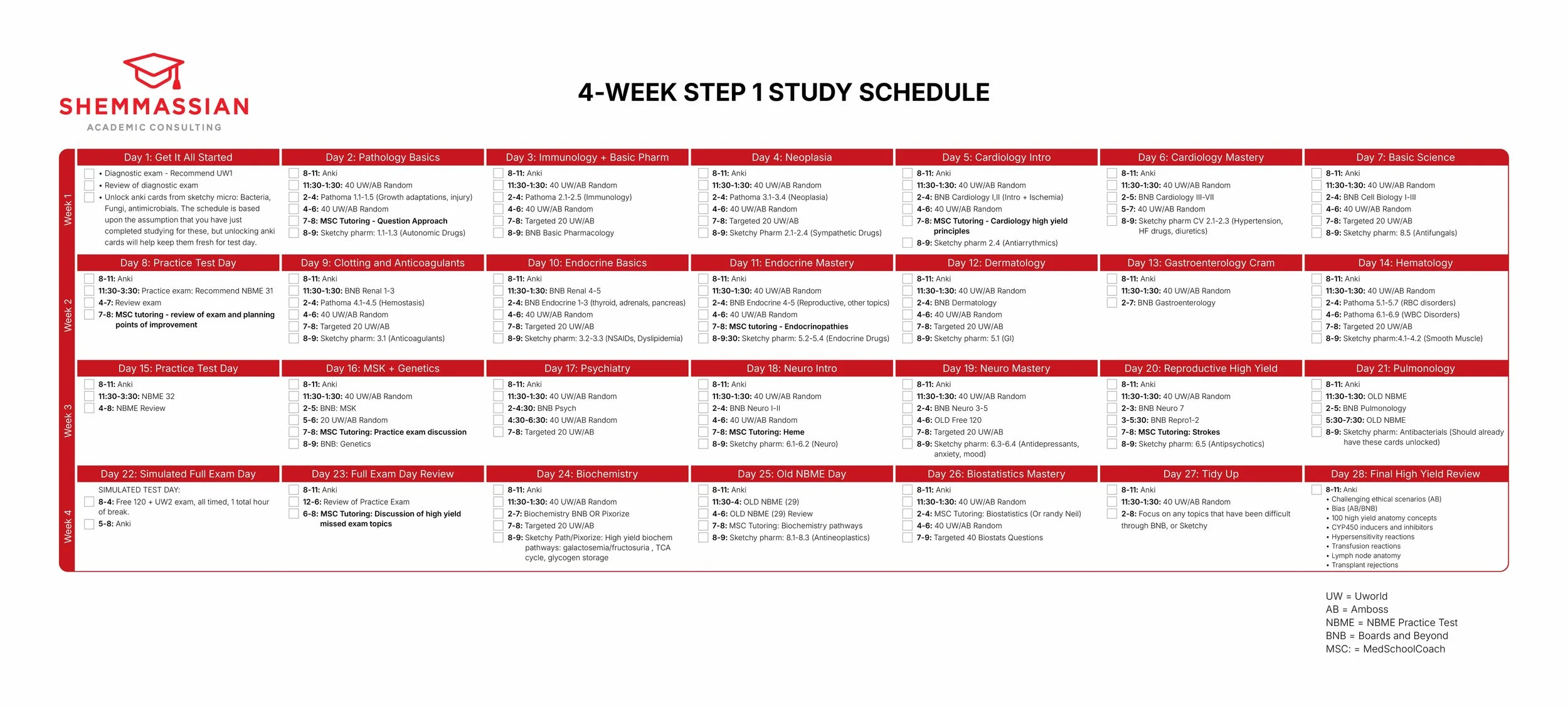
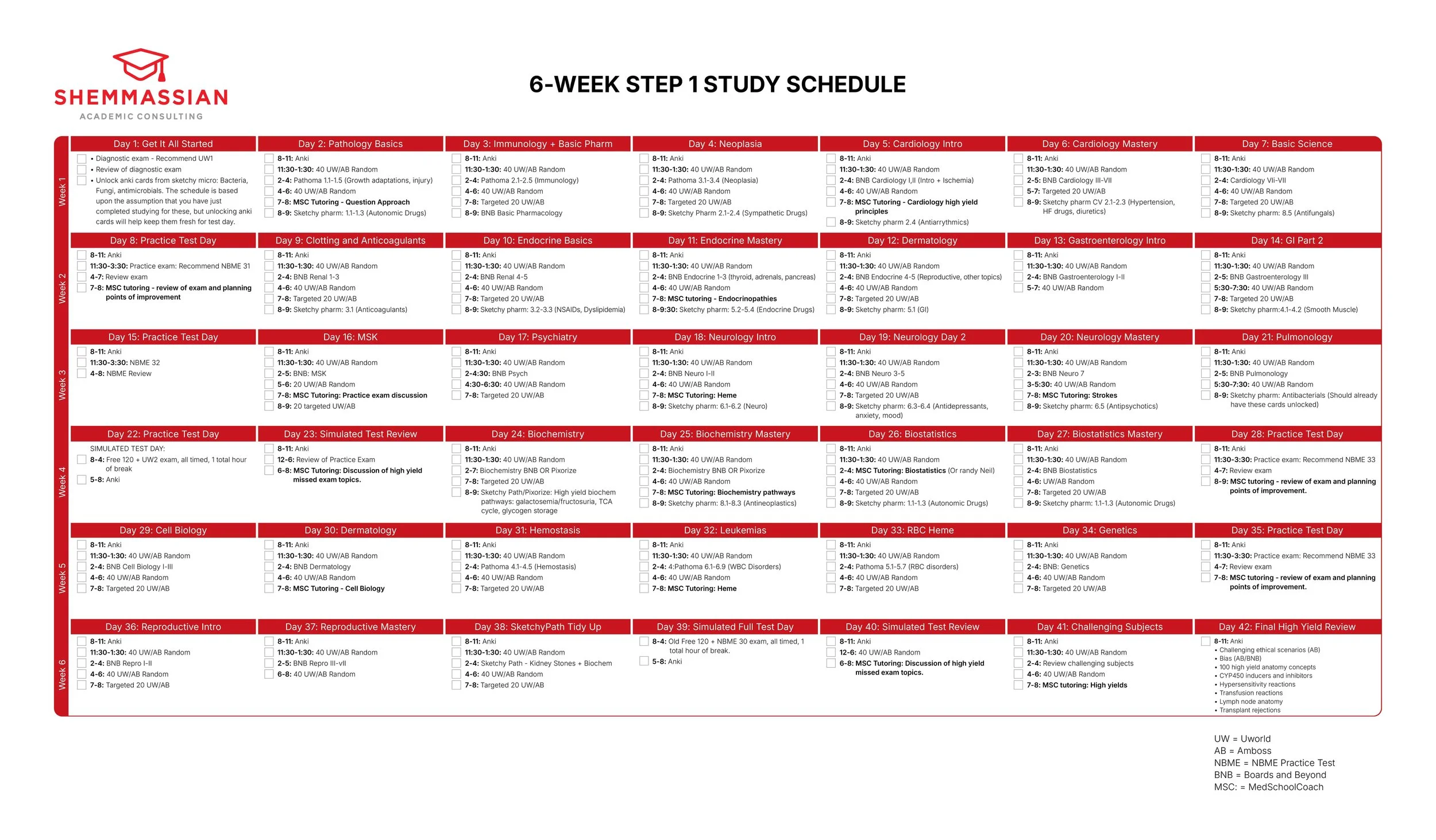
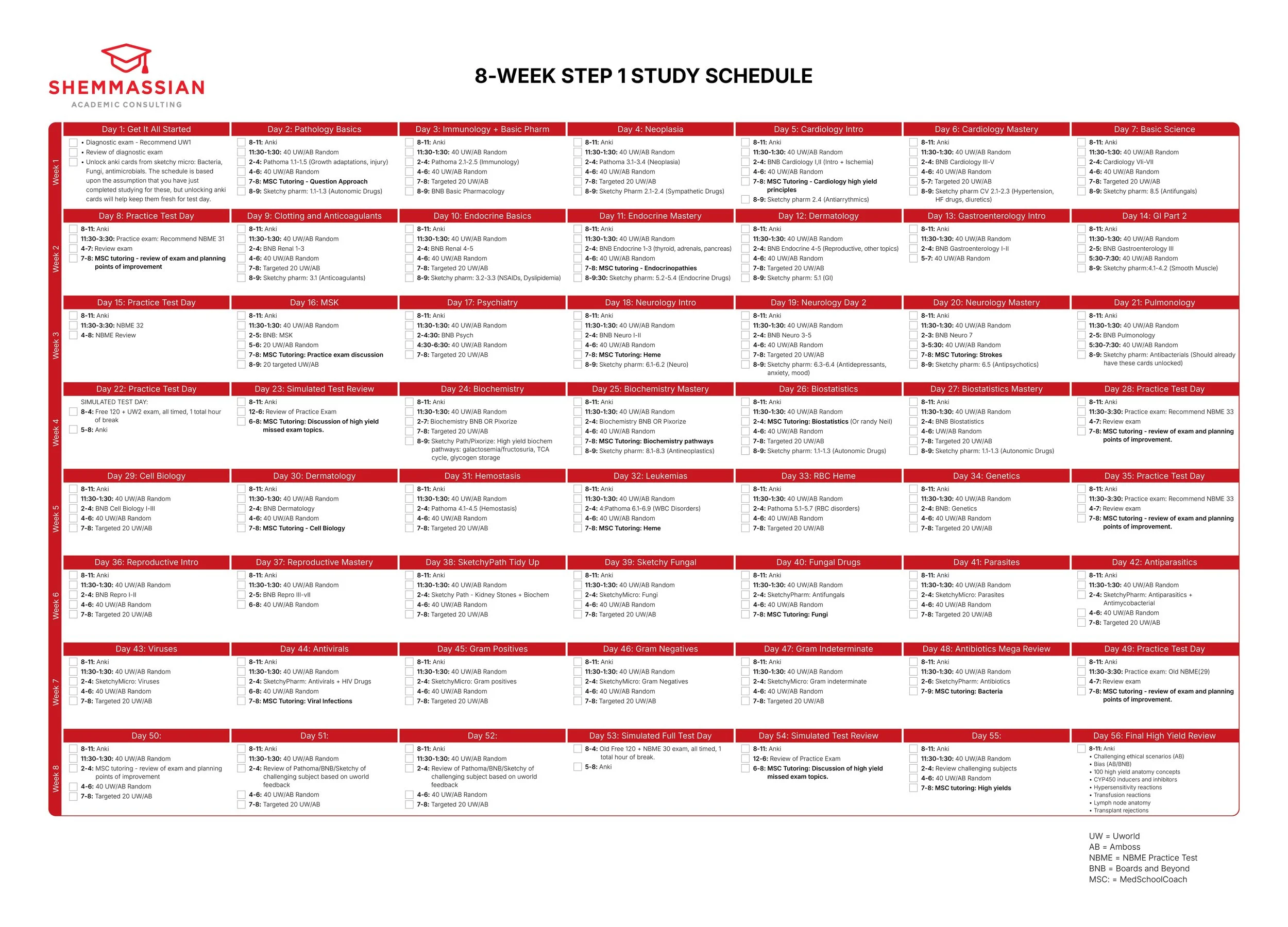
Want expert guidance on residency admissions?
Enter your name and email for high-yield admissions strategies we use to help students match into their top-choice programs
----
Part 4: Actionable advice to keep you on track for the USMLE Step 1
Preparing for the USMLE Step 1 requires more than just hard work; it demands a strategic approach to studying that ensures you’re using your time and resources effectively. One of the most important steps is to create a personalized study schedule that aligns with your strengths, weaknesses, and available time. Start by taking a diagnostic test to identify areas where you need the most improvement. Use this information to allocate more time to high-yield topics, such as pathology, pharmacology, and physiology, which are heavily tested on Step 1. Break your study sessions into manageable blocks, focusing on one subject or system at a time, and incorporate active learning techniques like flashcards, practice questions, and spaced repetition to reinforce your knowledge.
Another key to success is mastering practice questions. The USMLE is not just about memorizing facts. It’s about applying your knowledge to clinical scenarios. Use question banks to simulate the exam experience and develop your critical thinking skills. After completing each question, review the explanations thoroughly, even for the ones you answered correctly. This will help you understand the reasoning behind each answer and identify any gaps in your knowledge.
Finally, don’t underestimate the importance of self-care during your USMLE Step 1 preparation! The exam is not only a test of your knowledge but also your endurance. Make sure to prioritize sleep, nutrition, and exercise to maintain your physical and mental health. Schedule regular breaks to avoid burnout and keep your mind fresh. Remember, the USMLE Step 1 is just one step in your medical journey, and it alone doesn’t define your entire career. By staying disciplined, focused, and balanced, you’ll be well-prepared to tackle the challenges of the USMLE Step 1 and take the next step toward becoming a physician.
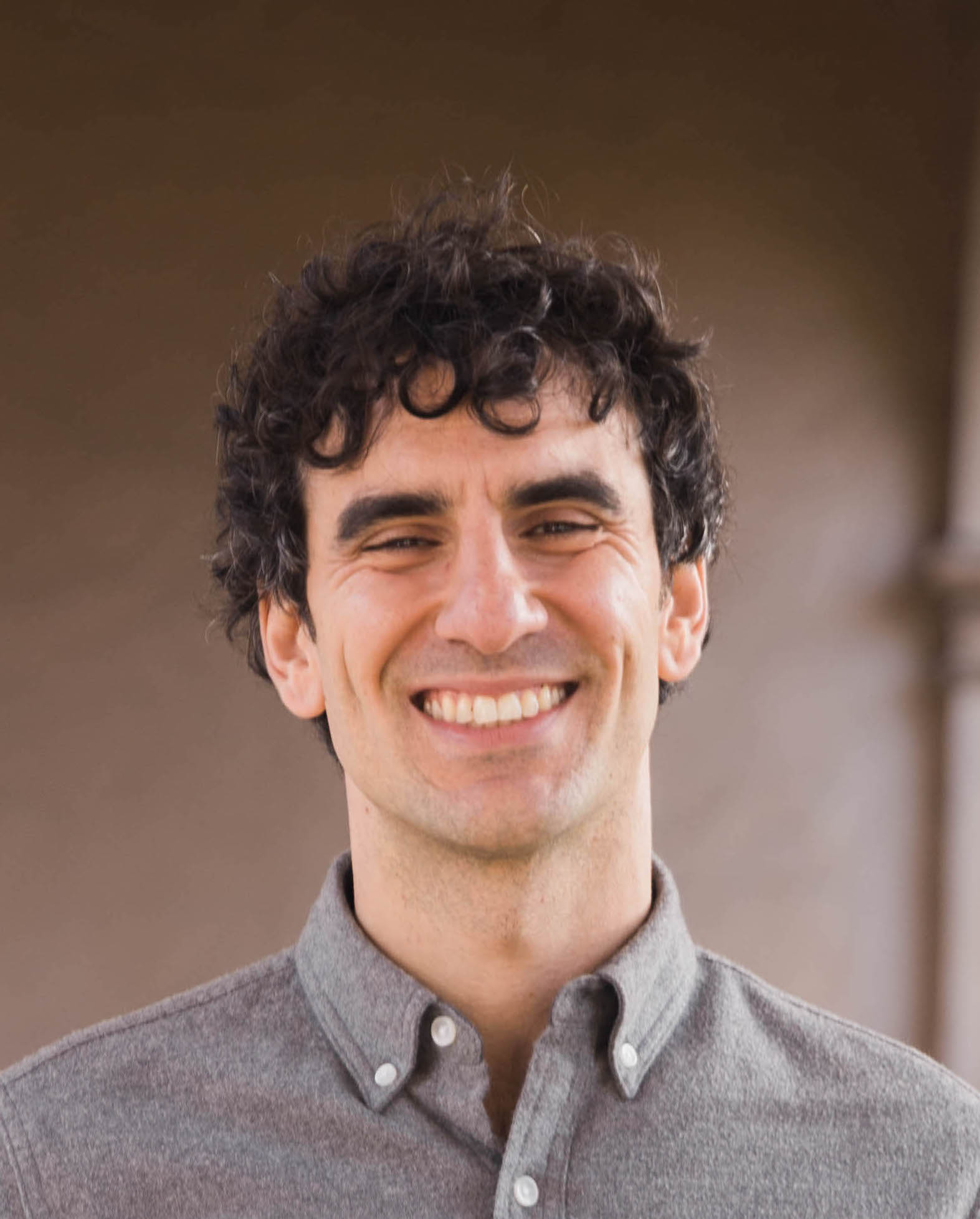
About the Author
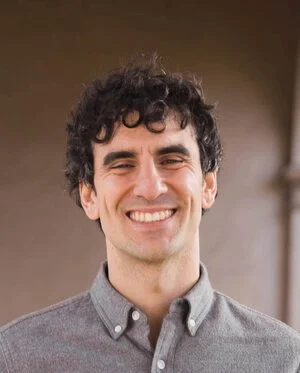
Dr. Shirag Shemmassian is the Founder of Shemmassian Academic Consulting and one of the world's foremost experts on medical residency admissions. For over 20 years, he and his team have helped thousands of students match to top residency programs using his exclusive approach.