Everything you need to know to navigate the Texas Medical and Dental Schools Application Service—from account setup to Match Day.

We'll walk you through every section of the TMDSAS application for the 2026-27 cycle.
The TMDSAS application step by step
Ideal TMDSAS timeline
Cost and waivers
TMDSAS match
How difficult is it to get into Texas medical schools?
TMDSAS vs. AMCAS vs. AACOMAS
Reapplying to TMDSAS schools
Appendix A: Schools that use TMDSAS
Appendix B: Texas schools that don’t require TMDSAS
If you're applying to medical school in the state of Texas, you've likely already encountered the name TMDSAS. But understanding exactly what it is, how it works, and how to complete it with precision is another matter entirely.
The Texas Medical and Dental Schools Application Service (TMDSAS) is the centralized application platform used by most public medical, dental, podiatry, and veterinary schools in Texas. Instead of submitting a separate primary application to each participating school individually, you complete a single TMDSAS application that is then distributed to every TMDSAS member institution you select. It's Texas's version of what AMCAS is to allopathic schools and what AACOMAS is to osteopathic schools–but with some uniquely Texan characteristics you won't find anywhere else.
TMDSAS operates on its own timeline, has its own essay prompts, its own activity entry system, its own residency requirements, and most distinctively, its own Match process—a structured algorithm that plays a central role in how Texas public medical schools distribute acceptances. If you plan to apply to Texas schools without a thorough understanding of how TMDSAS works, you're leaving your admission to chance.
This guide is designed to eliminate that risk. We'll walk you through every section of the TMDSAS application for the 2026-27 cycle (Entry Year 2027), covering what each section asks for, how to complete it thoughtfully, what to watch out for, and when key deadlines fall.
Whether you're a Texas resident applying to your home state's schools for the first time or an out-of-state applicant drawn to specific Texas programs, this is your definitive resource.
Want expert guidance on medical school admissions?
Enter your name and email for weekly advice plus our free 102-page guide to help you with every step: Get Into Medical School: 6 Practical Lessons to Stand Out and Earn Your White Coat
----
The TMDSAS application step by step
Account Setup and User Agreement
Your first step is creating an account on the TMDSAS website. Navigate to the TMDSAS application homepage and follow the prompts to register. You'll need a valid email address, which becomes your official communication channel for automated notifications. Once registered, you'll receive a unique TMDSAS ID, which you should keep handy throughout the entire application cycle. You'll need it when releasing MCAT scores, submitting documents through third-party services like Interfolio, and completing secondary applications at individual schools.
If you're a reapplicant who previously applied through TMDSAS since 2010, you do not need to create a new account. Simply sign in using the same email and password from your previous cycle. Most of your prior application data will pre-populate for review, though several sections—including your essays, letters of evaluation, proof of residency, and select schools—will not roll over and must be completed anew.
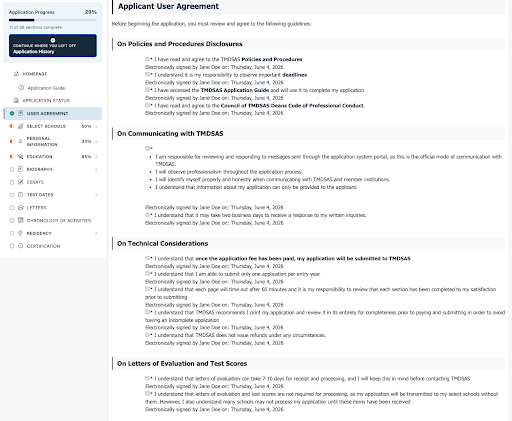
Once logged in, your very first task will be reading and accepting the User Agreement. This is not a formality. It is a binding agreement that outlines your responsibilities as an applicant and governs how you must conduct yourself throughout the cycle. Before you can proceed to any section of the application itself, you must agree to each statement in the following categories:
Policies and Procedures: You confirm that you've read the TMDSAS policies, understand all deadlines, have accessed the Application Guide, and agree to the Council of TMDSAS Deans Code of Professionalism.
Communicating with TMDSAS: You agree to use the internal messaging system as your official communication channel, to identify yourself honestly, and to understand that TMDSAS will respond to written inquiries within two business days.
Technical Considerations: You acknowledge that paying the application fee constitutes submission, that TMDSAS recommends printing your full application before paying to check for completeness, and that fees are non-refundable under any circumstances.
Letters of Evaluation and Test Scores: You acknowledge that letters and test scores are processed separately from your application and that their absence will not delay transmission, but that many schools will not review your file until these items are received.
Transcripts and Coursework: You agree to enter all coursework exactly as it appears on your official transcript, to use the TMDSAS Course Listings when coding entries, and to withhold transcripts until officially requested by TMDSAS (with limited exceptions).
Read every line of this agreement carefully. The terms here set the tone for your entire application experience.
Section 1: School selection
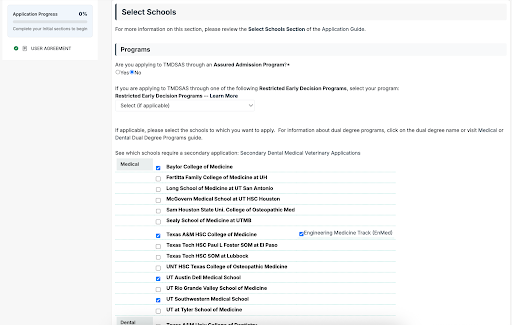
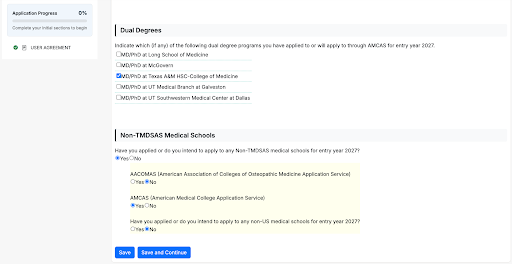
The first substantive section of the TMDSAS application asks you to select which participating institutions you want to apply to. For medical applicants, this means choosing from the 14 TMDSAS member medical schools. You may add or remove schools before submission, and in some cases, TMDSAS can add schools on your behalf after submission if you contact them through the internal messaging system. However, once your application is submitted, you cannot add dual-degree programs or non-TMDSAS schools (such as TCU Burnett School of Medicine, which uses AMCAS).
In this section, you'll also be asked whether you're applying to schools through AMCAS. If yes, indicate this. TMDSAS uses this information for context; it does not penalize you for applying broadly.
Keep in mind that you can apply to all TMDSAS medical schools for one flat fee (see the "Cost and Waivers" section below), so there is no financial penalty for a wider Texas school list, unlike with AMCAS. That said, applying broadly only makes sense if you've genuinely researched each school's mission and are prepared to write compelling additional essays for your secondary applications to each school. Casting a wide net without preparation rarely helps.
Section 2: Application history
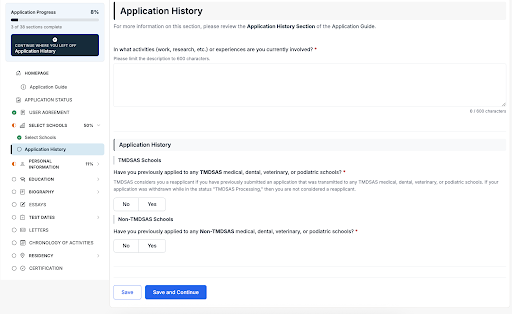
The Applicant History section collects information about your previous application history—both within TMDSAS and at non-TMDSAS schools. It's structured as a series of primary questions, each of which may generate follow-up questions based on your responses.
Key questions in this section include:
What activities are you currently involved in? You'll be asked to briefly describe your current involvements (600 character maximum). This is a short-answer field, not an essay—be concise and direct. Give concrete examples of goals you set and achieved, and provide quantifiable information (number of hours spent toward an activity, number of attendees to an event you coordinated, et cetera) whenever possible.
Have you previously applied to any TMDSAS schools? If your application was transmitted in any prior cycle, you are considered a reapplicant regardless of whether you submitted secondary applications or received any interview offers.
Have you previously applied to non-TMDSAS schools? If so, you'll indicate which schools and the outcomes of those applications.
Early Decision Programs: If you've ever previously applied to a Restricted Early Decision program, you'll indicate this here.
Prior Acceptance and Enrollment question: For reapplicants, you'll be given short-answer prompts (max 600 characters) specific to your reapplicant status. If you were previously accepted to medical school but didn’t attend, you’ll be asked to explain why. Or, if you were accepted and later left a program, withdrew, or were dismissed from it, you’ll be asked to explain the circumstances. Use this space thoughtfully—admissions committees already have your previous application on file, and they want to see meaningful growth, not a recycled narrative.
Section 3: Personal information
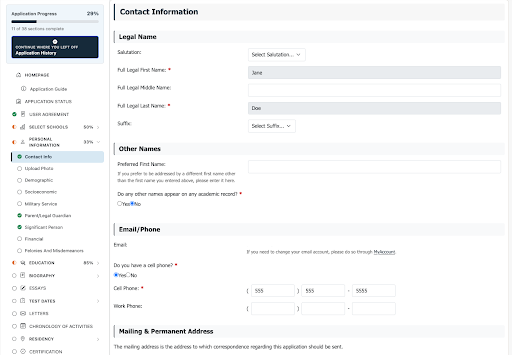
The Personal Information section collects your demographic, biographical, and contact details. While much of this is straightforward, a few areas warrant special attention:
Legal name vs. preferred name: Enter your full legal name exactly as it appears on official documents. This must match your MCAT registration and any other official records.
Contact Information: Provide a reliable address and phone number. TMDSAS sends important communications, and your address must be current. You can update your address after submission through the portal.
Upload photograph: This must clearly show your face, be less than 100KB, and formatted as JPG, GIF, PNG, or BMP.
Demographic information: You'll provide gender, ethnicity, and race information. TMDSAS uses this for holistic review and statistical reporting. These fields are optional, but completing them helps participating schools implement holistic admissions practices.
Socioeconomic Information: Here, you'll need to provide information about your family's socioeconomic background, including your estimated household income, whether you have a history of living in government-subsidized housing, whether you're bilingual/multilingual, whether you're a first-generation college graduate, whether you've dealt with food or housing insecurity, and more. There is also an optional short essay question with the following prompt:
In your formative years (0-8) and/or adolescent years (13-18), did you experience any of the following circumstances that disadvantaged you as an applicant? (Briefly explain your circumstances in 600 characters or fewer):
Material hardship and deprivation
Unemployment
Food insecurity
Housing instability
Residence in an area of high crime rate
Inadequate pre-literacy experiences
Inadequate after-school enrichment opportunities
If you choose to respond to this prompt, try to stick to specific examples of how these particular circumstances, obstacles, and hardships placed you at a disadvantage as a medical school applicant.
Military Service Information: If you ever served in the United States military, fill out this section of the application. You are given the option of uploading your military transcript, as well as responding to a prompt that reads:
Describe how your military experience prepared you for a career as a healthcare provider. (Limit: 1000 characters).
We highly recommend that you respond to this prompt and use specific examples to show how your service has developed you in areas such as leadership, communication, cultural sensitivity, and empathy.
Parent/Legal guardian information: Provide information about your parents' occupation, birth country, address, etc. You'll also be asked to input basic information about your siblings, as well as whether you have any relatives who are studying or practicing medicine.
Significant Person Information: If someone other than your parents/legal guardians helped to raise, provide, or care for you, you may enter their information here.
Financial Information: You're asked to describe what percentage of your college and/or current postgraduate living expenses (including college tuition, room and board, and other living expenses) have been provided by the following sources: family, spouse, academic scholarships, financial need-based scholarships, loans, jobs/employment, and other sources. There's no way to calculate this exactly, of course, but do your best to provide an accurate estimate.
Felonies and Misdemeanors: You’ll be asked whether you’ve ever been arrested or charged with any violation of the law, with some exceptions. It is essential that you respond honestly to this question. If the answer is yes, you are required to write a full explanation within 600 characters.
Section 4: Education history
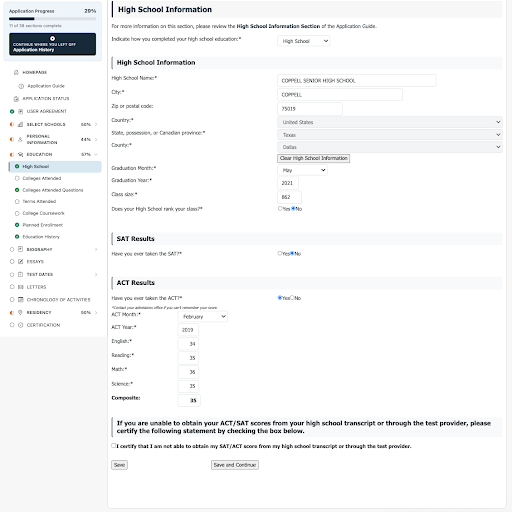
The Education History section asks about your academic background from high school onward. You'll need to provide:
High school information: Name, location, graduation year, class size, and class rank (if your school provides it). You'll also enter SAT and/or ACT scores here if applicable.
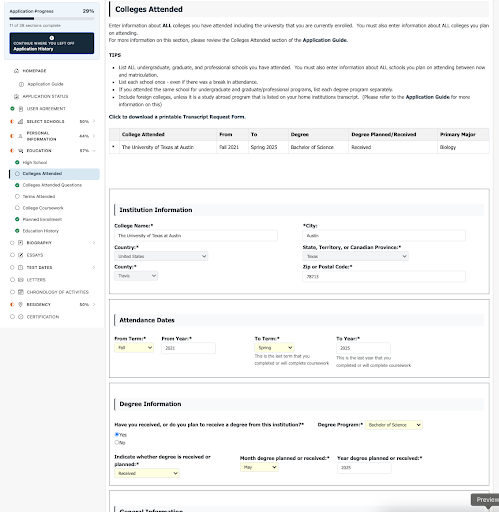
Colleges attended: List every institution where you completed any coursework — community colleges, summer programs, study abroad institutions, and transfer schools included. You'll enter dates attended, degree type, major(s), minor(s), and graduation status for each. You'll also be asked to insert information about your major and whether you were enrolled in an honors program. Be sure not to omit any institution, even if you only took one class there. TMDSAS verifies this against your official transcripts. Missing schools trigger processing delays.
Colleges Attended Questions: For each institution, you'll answer whether you'd like to release your application information to the health professions advisors at that school. If you're using an HPAC (Health Professions Advisory Committee) letter from a particular institution, you must answer "Yes" to this question for that school — it's what allows your advisor to access your application in the TMDSAS Advisor Portal.
Terms Attended: Here, you’ll enter information for every single term you attended at each institution.
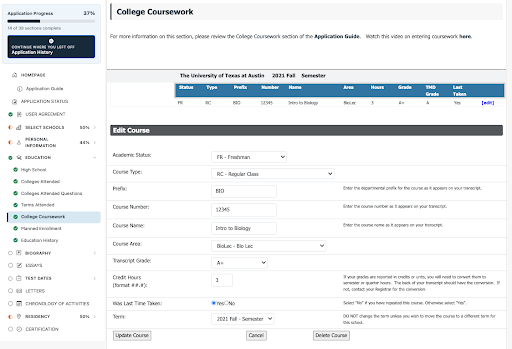
College Coursework: Be prepared to input extensive information about every single course you've ever taken at the college level. You must enter this manually, one course at a time, so be sure to set aside plenty of time to complete this section.
Transcripts
Unlike AMCAS, which requires transcripts from all applicants upfront, TMDSAS does not require transcripts from all applicants at the time of submission. Instead:
For dental, medical, and podiatry applicants: TMDSAS sends transcript requests only to applicants who have received acceptances.
For veterinary applicants: Transcript requests go to applicants who have been interviewed.
Do not send transcripts to TMDSAS before receiving an official request. Transcripts submitted before the request is sent will not be kept on file.
Some exceptions do apply, in which case applicants should send transcripts as soon as Spring 2026 grades are available:
Applicants to Early Decision Programs (EDP)
JAMP applicants
Applicants who elected the Academic Fresh Start Provision
Applicants with foreign coursework
What transcripts are required?
When requested, TMDSAS requires official transcripts from every institution where you completed college-level coursework. These are the same institutions you listed in your Education History. Official transcripts must be mailed (or submitted electronically through approved services) directly from the institution to TMDSAS. You cannot submit them yourself.
Transcript freshness: Transcripts submitted to TMDSAS must have been issued within the past year (the print date cannot be more than 12 months before submission). If you're a reapplicant, transcripts from prior cycles will not be rolled over, so you'll need fresh ones.
Section 5: Coursework
The Coursework section is one of the most time-consuming parts of the TMDSAS application—and one of the most important to get right, because errors here can delay your application and potentially create PCR (Prerequisite Coursework Report) deficiencies that follow your file through the cycle.
Here's what you'll be doing: entering every college course you have completed or are planning to complete, from every institution you've attended, including the course name, course number, subject area code, credit hours, grade, and semester/term.
What must be included:
All college-level coursework from every institution attended, including community college, transfer credits, dual-enrollment credits, AP/IB credits, study abroad, and graduate coursework.
Planned (future) coursework
Education/Training History: Depending on your individual circumstances, you may be required to respond to a few prompts here:
If you’re a non-traditional applicant, you must describe what makes you a non-traditional candidate for medical school admission and how they impact your application within 1,000 characters. If your education or vocation has ever been interrupted, you must explain the circumstances (including relevant dates of when those interruptions occurred) within 600 characters. Keep in mind that being a nontraditional applicant or having taken a break from your academic or professional pursuits does not inherently place you at a disadvantage. For more information on how to approach your medical school application as a nontraditional applicant, check out our comprehensive guide on Getting into Medical School as a Nontraditional Applicant.
If you’ve ever been the recipient of disciplinary action at the academic or professional level, you must explain the circumstances.
As with all of your essays, be fully straightforward and honest, and focus on your growth journey. How have these experiences or circumstances shaped you into someone who is prepared for the rigors of medical school and a career in medicine?
A few critical best practices for this section:
Use the TMDSAS Course Listings. TMDSAS maintains official course listings for hundreds of Texas institutions. Before entering a course, consult tmdsas.com/course-listings (https://www.tmdsas.com/course-listings/index.html) to confirm how that course should be coded. Coding errors are one of the most common processing problems and can cause unnecessary PCR deficiencies.
Enter courses exactly as they appear on your transcript. The name, number, and credit hours should match precisely.
Do not combine labs and lecture components if they appear as separate line items on your transcript. Enter them separately.
AP credits require a specific entry method. Consult the TMDSAS Application Guide's section on AP credits before entering them.
Save frequently. The page times out after 60 minutes. Do not lose work.
After your application is transmitted, TMDSAS generates your PCR (Prerequisite Coursework Report), which shows whether you've met the prerequisite requirements for TMDSAS schools. Review this document carefully once it's available. PCR deficiencies do not prevent your application from being reviewed, but it's important to be aware of any gaps and to address them proactively.
Section 6: Personal biography and activities
If the essays are your voice, the Personal Biography section is your résumé—and it's one of the most consequential sections of your TMDSAS application. Admissions committees use it to understand the breadth and depth of your experiences, to identify whether you've developed the core competencies required of future physicians, and to find the experiences that make you distinctively you.
The TMDSAS activities section differs from AMCAS's "Work and Activities" in several important ways. While AMCAS allows up to 15 entries with up to 700 characters per description, TMDSAS has no maximum on the number of activities you may list. However, the character limit per entry is more constrained—300 to 500 characters per entry, depending on the category.
Include all activities from high school graduation through the end of September of your medical school application year. This feeds directly into the Chronology of Activities (see below).
Activities are entered under the following categories:
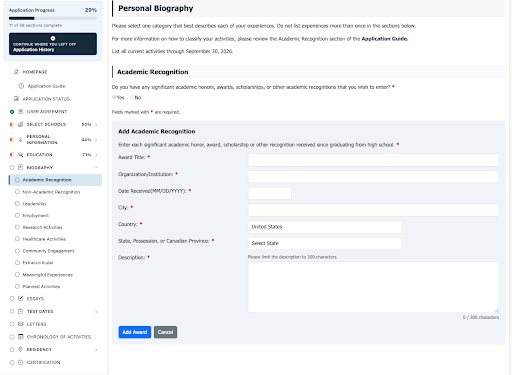
Academic Recognition (honors, scholarships, dean's list)
Non-Academic Recognition (awards, achievements outside academics)
Leadership (organizational leadership roles)
Employment (paid work experience)
Research Activities (lab, clinical, or community-based research)
Healthcare Activities (clinical experience, shadowing, medical volunteering)
Community Engagement (non-healthcare volunteering)
Extracurricular (clubs, sports, hobbies, arts)
Meaningful Experiences (Anything else you feel has been formative in your journey to med school)
Planned Activities (experiences you plan to complete before matriculation)
One nuance to keep in mind is that healthcare activities and employment may overlap. If a position was paid and healthcare-related (like medical scribing or patient transport), it should be listed under both Healthcare Activities and Employment. Otherwise, do not list the same experience in more than one category.
Each entry includes: activity name, organization/institution name, dates, hours per week, total cumulative hours, location, and a 300-500 character max description explaining how this activity impacted you, how you impacted others through this activity, and how this activity has shaped your journey toward a career in medicine. TMDSAS automatically sorts your entries chronologically—you cannot manually rearrange them.
Use the description space to convey genuine reflection and personal growth, not just a summary of what you did. Use quantitative data whenever possible, and avoid generic language. For example, replace "helped patients feel comfortable" with “counseled 5–10 patients daily on post-surgical wound care.” But don’t forget to include humanizing aspects of your experiences, such as meaningful interactions with community members, co-workers, or patients; epiphany moments you experienced over the course of the activity; and challenges you worked to overcome. Admissions committees want to see that you've engaged meaningfully with medicine and community rather than just padding your list with impressive-sounding roles and experiences.
For more information on which extracurriculars will make you a competitive med school applicant, visit our guide on How to Choose the Right Extracurricular Activities for Med School.
Section 7: Essays
The essays section may be the most important in terms of your ability to distinguish yourself, and it deserves more preparation time than most applicants allocate to it. For medical applicants,
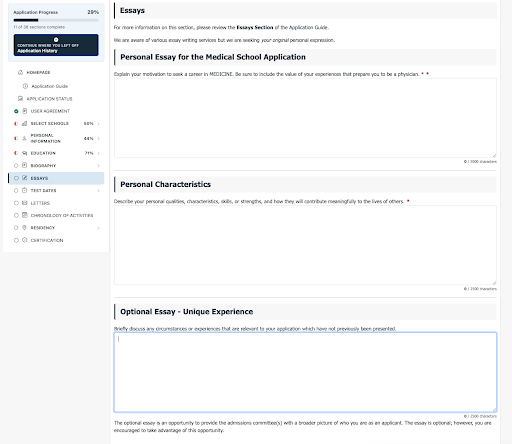
TMDSAS requires three essays—two required and the third strongly encouraged. Please note: Below we have provided a general overview of the prompts and how to approach them, but be sure to visit the Essays section of our TMDSAS Ultimate Guide, which provides in-depth explanations and full-length essay examples.
Essay 1: Personal Essay for the Medical School Application
Prompt: Explain your motivation to seek a career in medicine. Be sure to include the value of your experiences that prepare you to be a physician. Character limit: 5,000 characters (including spaces).
This is functionally equivalent to the AMCAS personal statement (which allows 5,300 characters), meaning most applicants can adapt their AMCAS statement for TMDSAS with minor trimming. The core purpose is identical: explain why medicine, why now, and why you specifically are prepared.
Strong TMDSAS personal statements are specific, reflective, and narratively coherent. They do not read like chronological summaries of your résumé; they tell a story. The best ones have a clear through-line: a central insight or moment that crystallizes your motivation and ties your disparate experiences together into a unified portrait of a future physician.
Essay 2: Personal Characteristics Essay
The new prompt for EY2027 asks: Describe your personal qualities, characteristics, skills, or strengths, and how they will contribute meaningfully to the lives of others. Character limit: 2,500 characters (including spaces)—reduced from 5,000 in prior cycles.
This is the essay most commonly underestimated by first-time TMDSAS applicants. Note that the EY2027 character limit has been reduced significantly from previous cycles, so if you're a reapplicant, your prior essay cannot simply be reused.
As you formulate your response, try to narrow your focus down to any quality that distinguishes you and shapes the contributions you'll make to the medical field. Intellectual background, formative experiences, cultural perspective, professional skills, personal values—all of these are fair game. The key is connecting your qualities to tangible impact: how will who you are make a difference in the lives of patients, colleagues, and communities?
Essay 3: Optional Essay
Prompt: Briefly discuss any circumstances or experiences that are relevant to your application, which have not previously been presented. Character limit: 2,500 characters (including spaces).
The word "optional" is somewhat misleading. TMDSAS strongly encourages all applicants to complete this essay, and admissions deans have noted that failing to use it can feel like a missed opportunity. Use it to address something genuinely new—a gap year, an unexpected hardship, a research experience you couldn't fit elsewhere, an unusual aspect of your background. Do not use it to repeat or summarize your other essays.
Technical tips for all essays:
Type directly into the TMDSAS portal — do not copy and paste from Microsoft Word, Google Docs, or similar applications. Formatting from word processors can introduce invisible characters that create display issues that cannot be corrected after submission.
Save constantly. The application times out after 60 minutes.
Spaces count toward your character limit.
No abbreviations or shorthand. Write in complete sentences.
Essays cannot be changed after submission under any circumstances. Proofread multiple times before paying. Print your application and read the essays on paper; errors that are invisible on screen are often visible in print.
Section 8: Test scores
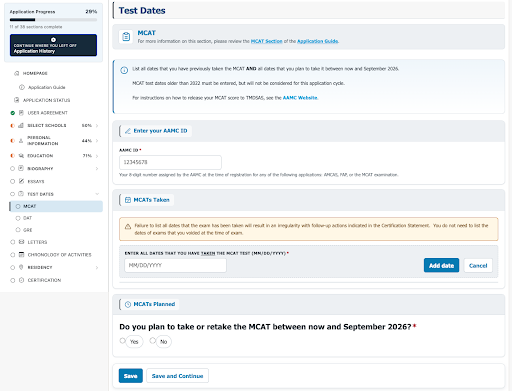
In this section, you'll enter your information for all MCAT attempts (and GRE attempts, if you've taken it).
Here is what you need to know:
MCAT scores are NOT automatically sent to TMDSAS. Unlike AMCAS, which automatically receives MCAT scores for AMCAS-designated schools, TMDSAS requires you to manually authorize the release of your scores through your AAMC account. Go to the AAMC portal, find the score release option, and send your scores to TMDSAS
Score validity: For the EY2027 cycle, MCAT scores from tests taken before January 2022 will not be accepted (five-year validity window). Check the official TMDSAS policies page for current validity dates.
All test attempts are transmitted. TMDSAS sends all of your MCAT scores to the schools you've selected—not just your best score. Schools can see every attempt.
Multiple exams: If you've taken tests other than the MCAT (e.g., DAT, GRE), you'll indicate that here, though you do not need to release those scores if they're not required for your program type.
MCAT scores received after submission: You do not need to resubmit your application when a new MCAT score is released. Once you authorize the release, scores are added to your file automatically, and schools are updated within approximately 36 hours.
Test dates: Entering planned test dates is possible even before scores are available. Update the section when your score is released.
Some schools also require CASPer (a situational judgment test) as an additional component. CASPer is not submitted through TMDSAS—you register separately at takealtus.com using your TMDSAS ID. CASPer scores are valid for one admissions cycle only, so reapplicants must retake it. See the "After Submitting" section for a list of schools requiring CASPer.
It's important to note that you must not omit any test dates here. This will cause a delay in your application as TMDSAS follows up with you, and it could significantly harm your chances of admission. Honesty is the best policy, even if you aren't proud of all your scores.
Section 9: Letters of evaluation
TMDSAS requires three letters of evaluation for medical school applicants (or one Health Professions Committee letter/packet in lieu of three individual letters). You have the option to submit one additional (fourth) letter.
Who should your letters come from?
TMDSAS recommends that evaluators know you well enough to speak to you both academically and personally, and that at least one evaluator be a current or former professor who can speak directly to your academic ability in the sciences. Beyond that, a well-rounded letter set typically includes a blend of academic and clinical perspectives. For example, a science professor, a physician you shadowed or worked with, and a research mentor or supervisor.
Strong letters are specific and personal; they recount concrete examples, use your name frequently, and demonstrate that the evaluator actually knows you. Generic, brief, or impersonal letters (even from impressive people) carry less weight than detailed, authentic ones from evaluators who can describe real interactions.
How to set up your letters:
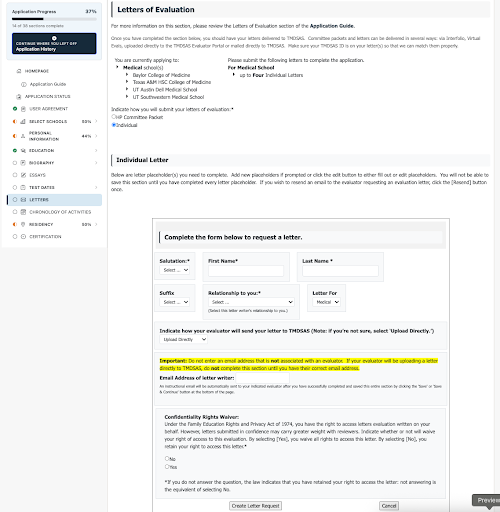
Navigate to the Letters of Evaluation section and select either the HP Committee Packet or the Individual letter option.
If you choose the HP Committee Packet option, you must ensure that your HP advisor is the one uploading it through the Advisor Portal (not the Evaluator Portal). Unlike individual letters, the system does not automatically notify advisors, so you must contact your HP office directly.
If you choose the individual option, you’ll enter the information for all three required evaluators at once. After you click Save, TMDSAS automatically sends an email to each evaluator directing them to the TMDSAS Evaluator Portal. You must create all three placeholders simultaneously and save them in one action for the emails to go out. Saving incomplete or partial entries will not trigger the notifications.
Submission methods:
Direct Upload (preferred): Your evaluator uploads directly through the TMDSAS Evaluator Portal. Allow up to 10 business days for processing (longer during the May–July peak).
TMDSAS Evaluation Form: A structured form that evaluators complete online. Processes within 1 business day.
Interfolio: Letters submitted through Interfolio or Virtual Evals can be delivered electronically. Allow up to 14 business days. Critical note: if you send letters in multiple Interfolio deliveries, the submission date for ALL letters resets to the date of the most recent delivery, so plan accordingly.
Mail: Evaluators may mail letters directly to TMDSAS. Letters must be mailed by the evaluator, not by you.
Letter requirements:
All letters must be on official or personal letterhead, include the evaluator's contact information, be addressed to admissions committees, include your name and a date (letters should be dated after May 1, 2025 for EY2027), be written in English, and bear the evaluator's signature.
Deadline: Letters should be uploaded or postmarked by October 15, 2026. TMDSAS will continue to accept letters after this date, but individual schools may not.
Section 10: Chronology of activities
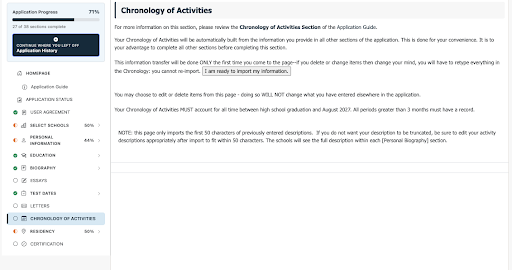
The Chronology of Activities is automatically generated by TMDSAS based on the information you've entered across the rest of your application. You don't build it manually; it compiles the information you’ve entered throughout your application into a chronological timeline that functions as a comprehensive CV for admissions committees.
Important note: You only have one chance to import the information by clicking the “I am ready to import my information” button. If you delete or change items, you will have to re-enter everything manually.
The chronology must account for all activities between your high school graduation and August 2027. According to TMDSAS policy, any gap greater than three months must have a corresponding entry. This means that if you took time off, traveled, or had a period of inactivity, it should be documented somewhere in your application. A clean, gap-free timeline signals to adcoms that you are an organized, thoughtful applicant.
Before submitting your application, view your Chronology in the application and scan for any gaps that might appear unexplained. If there's a stretch of time not accounted for, add a "Planned Activities" entry or consider whether it should appear in another category.
And be aware that any activity descriptions will be truncated to 50 characters in the Chronology section, so you’ll want to revise them to brief summaries within the Chronology section. (Schools will see the full descriptions within each individual section of the application, but the Chronology section will provide them with a bird’s-eye view of your application).
Section 11: Residency
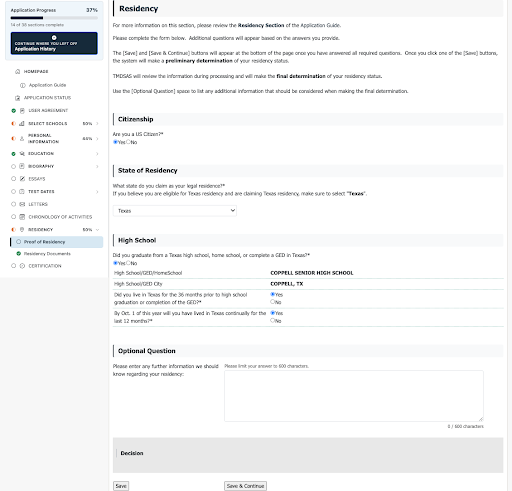
Texas state law reserves at least 90% of entering class seats at public medical schools for Texas residents—making your residency classification one of the most consequential determinations in your entire application. The Residency section is where TMDSAS gathers the information needed to make this classification.
TMDSAS cannot confirm your residency status before reviewing your completed, submitted application. The system generates an initial automatic classification based on your responses, but this is not final. A TMDSAS applicant liaison (who is also a residency specialist) reviews your application in detail during processing and makes the official determination.
Texas Residency is established in two primary pathways:
Option 1: Texas High School Graduation
You must have graduated from a Texas high school (or received a Texas GED), lived in Texas for the 36 months immediately preceding that graduation, and lived continuously in Texas for the 12 months immediately before the October 1, 2026 application deadline.
Option 2: Establishing Domicile
You (or your parent, if you are claimed as a dependent) must have lived in Texas for 12 consecutive months before the application deadline AND established and maintained domicile for those 12 months by means of one of the following: gainful employment in Texas, sole or joint marital ownership of Texas residential property, ownership and operation of a Texas business, or being married for at least one year to a person who has established Texas domicile.
Important distinction: Simply attending college in Texas does not qualify you as a Texas resident for TMDSAS purposes. Living in Texas for school is not the same as establishing domicile. For more in-depth information regarding how to qualify for Texas residency, visit our guide on Picking Your State of Residency for Medical School.
What to select: If you are claiming Texas residency—regardless of whether you currently live out of state for school—you must select "Texas" as your state of legal residence in the dropdown menu. Applicants frequently make the mistake of selecting their college state.
After submission, depending on your responses, TMDSAS may request that you upload supporting documentation (pay stubs, Texas driver's license, warranty deed, utility bills, marriage certificate, etc.) through the application portal. Upload these documents promptly — delays in providing residency documentation directly delay your application processing.
If TMDSAS classifies you as a non-Texas resident and you believe the determination is incorrect, you may file a Residency Appeal. The Residency Review Committee reviews all appeals on a case-by-case basis within 15 business days of receiving complete documentation.
Certification and submission
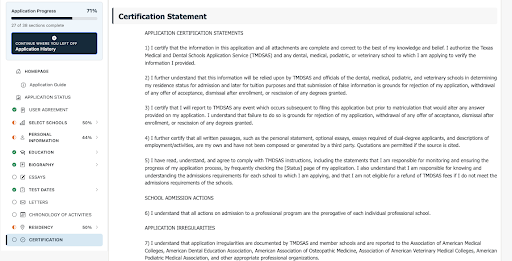
The Certification section is the last stop before your application is officially submitted. Here, you'll review and agree to a final set of certification statements affirming that your application is accurate, truthful, and complete, and that you understand TMDSAS's policies on processing, GPA calculation, school admission decisions, and application irregularities.
Before clicking "Pay and Submit," do the following:
Print your entire application (TMDSAS strongly recommends this). The application generates a PDF you can download. Read it in full on paper, not just on screen. Errors are easier to spot on a printed page.
Check every section status. The application's Status page shows whether each section has been completed and saved.
Confirm your essays are final. Essays cannot be changed under any circumstances after submission. Read them one more time.
Verify your school selection. Make sure you've selected every TMDSAS school you intend to apply to.
Confirm your coursework entries. Grade errors or missing institutions are common and create processing delays.
Once you proceed to the Payment page, you'll enter a $235 credit card payment (the current EY2027 application fee). This fee is non-refundable, and your application is considered submitted upon payment. Do not navigate away from or refresh the payment page until the transaction is confirmed.
After submission, TMDSAS typically processes and transmits applications to selected schools within four weeks (up to six weeks during peak periods). Missing letters and test scores will not delay your primary application processing.
----
Ideal TMDSAS timeline
Below is a recommended month-by-month timeline for applicants targeting Entry Year 2027 (matriculation Fall 2027). Note that "early" in the TMDSAS context means submitting as close to the May 15 opening as possible/ Texas medical schools review on a rolling basis, and earlier files receive earlier consideration.
January–March 2026: Begin drafting all three TMDSAS essays. Research each school's mission statement and secondary essay prompts. Identify and approach letter of evaluation writers in order to give them ample time to work on their recommendations.
April 2026: Finalize your essays. Request letters of evaluation from all three evaluators. Confirm their email addresses and availability. Register for CASPer if your target schools require it (take it before mid-June if possible).
May 1, 2026: TMDSAS application opens at 8:00 a.m. CST. Log in, and begin completing sections immediately. Do not wait; this application is extremely extensive, and its user interface often causes frustration among applicants. Save yourself from the stress of trying to fill it out at the last minute.
May 15, 2026: Earliest submission date (application opens for submission at 8:00 a.m. CST). Applicants who are fully prepared should aim to submit on or very near this date.
May–June 2026: Ensure all three letter of evaluation placeholders are created and saved (triggering email notifications to your evaluators). Begin and complete any required secondary applications; some schools' secondaries open immediately upon receiving your TMDSAS application.
Mid-June 2026: Last recommended date to take CASPer or AAMC PREview if required by your target schools.
August 3, 2026: Submission deadline for Early Decision Programs (EDP) at TTHSC SOMAAMC, UNTHSC TCOM, UTRGV SOM, and several TAMU SOM special programs.
August 17, 2026: Deadline for all supporting documents (transcripts, letters, test scores) for Early Decision Program applicants.
August 15, 2026: Latest recommended date to submit all secondary applications.
October 1, 2026: Application deadline for all medical programs (11:59 p.m. CST). All sections must be complete, and payment must be submitted. TMDSAS does not grant deadline extensions under any circumstances. This is also the date Early Decision Program decisions are announced.
October 15, 2026: Medical schools begin extending offers of acceptance. Letters of evaluation should be uploaded or postmarked by this date.
October–December 2026: Interview season. Prepare thoroughly. Review each school's mission, practice behavioral interview questions, and know your application inside and out. Learn crucial med school interview strategies and practice with sample questions by visiting our How to Ace Medical School Interviews guide.
January 29, 2027: Deadline to submit your school preference ranking for the TMDSAS Match (5:00 p.m. CST). All interviewed Texas resident medical applicants must rank every school at which they interviewed. Failure to rank by this deadline results in automatic withdrawal from all medical schools.
February 12, 2027: Match results announced. Rolling admissions period begins.
April 30, 2027: Medical applicants holding multiple offers must select one school and withdraw from all others.
May 15, 2027: Texas medical schools can no longer make offers to Texas resident applicants who are already holding a seat at another Texas school.
If you’re also applying to schools outside of Texas, be sure to follow the detailed guidance laid out in our Ideal Medical School Application Timeline guide, which includes all the dates and deadlines you’ll need to be aware of for AMCAS and AACOMAS applications.
----
Cost and waivers
The TMDSAS application fee for EY2027 is $235, payable by credit card only. This is a flat fee, so regardless of whether you apply to 1 school or all 14 TMDSAS medical schools, you pay $235 once. This is one of the most applicant-friendly aspects of TMDSAS compared to AMCAS, where fees accumulate per additional school.
The fee is charged at submission and is non-refundable under any circumstances, including if you withdraw your application, if you are deemed ineligible, or if you do not gain admission.
Be aware that TMDSAS does not grant application fee waivers. Unlike AMCAS, which has a fee assistance program, there is no equivalent waiver system for TMDSAS. This is an important financial planning consideration for applicants, particularly those who are also paying AMCAS fees for out-of-state schools.
Also note that secondary application fees are separate and paid directly to individual schools—they are not covered by or connected to the TMDSAS fee.
----
TMDSAS match
The TMDSAS Match is one of the most distinctive features of applying to Texas medical schools—and one that catches unprepared applicants off guard every year.
What it is:
The TMDSAS Match is a structured, algorithm-based process, unique in U.S. medical school admissions, that coordinates how Texas medical applicants are matched to TMDSAS member schools at the conclusion of the interview season. It is designed to give applicants maximum ability to express their preferences while ensuring that schools fill their entering classes in a fair, coordinated way.
Who participates:
Only Texas resident medical applicants who have been interviewed by at least one TMDSAS school participate in the Match. Non-Texas residents, MD/PhD applicants, DO/PhD applicants, MD/MBA applicants, and applicants in certain Assured Acceptance Programs are not part of the Match process.
How it works:
Between October 15 and January 31, schools may extend pre-match offers of acceptance to Texas residents. You may hold multiple pre-match offers simultaneously without penalty.
By January 29, 2027 at 5:00 p.m. CST, you must log into your portal and enter your school preference ranking—listing every school at which you interviewed in order of your preference. Schools do not see your rankings; their own ranking of you is independent of your preferences.
TMDSAS runs the matching algorithm, which pairs applicants with their highest-ranked school at which they also fall within that school's selection range.
Match results are announced February 12, 2027.
Key rules to understand:
You must rank all schools where you interviewed, even if you interviewed at only one school, even if you don't want to attend.
If you're holding a pre-match offer and you rank another school higher, you can match to that higher-ranked school without losing your pre-match offer as long as you don't actually match there.
If you match to a school ranked higher than your pre-match offer school, you are automatically withdrawn from the pre-match offer school and all lower-ranked schools.
Failing to submit your school preference ranking by the deadline will result in automatic withdrawal from all TMDSAS medical schools. There are no exceptions to this rule, so be sure to set a calendar reminder.
If you don't match:
The rolling admissions period begins immediately following Match Day and continues through the start of orientation. Schools contact applicants from their alternate lists during this window, so it’s essential to stay responsive and check your portal regularly.
Pre-match offers
Between October 15, 2026 and January 31, 2027, TMDSAS medical schools may extend pre-match offers of acceptance to Texas resident applicants. These are genuine, formal offers of acceptance, but they are not binding on either side during the pre-match period.
What you should know:
You may hold offers from multiple schools simultaneously during the pre-match period. No school can withdraw an offer simply because you're also holding an offer from another school.
An offer is only valid if you receive an official written (typically electronic) acceptance letter. Verbal or informal communications from interviewers do not constitute offers.
If you receive an offer from a school you are certain you would not attend, it is courteous (and ethically expected)to decline promptly so that spot can go to another applicant.
Accepting a pre-match offer does not lock you in. You still participate in the Match, and you can rank schools you didn't receive pre-match offers from higher than your pre-match offer school. If you match to a higher-ranked school, the pre-match offer is automatically withdrawn.
----
How difficult is it to get into Texas medical schools?
Gaining admission to medical school is difficult, and Texas medical schools are no exception. The competitiveness will vary meaningfully depending on whether you're a Texas resident or an out-of-state applicant.
For Texas residents, the landscape is challenging but genuinely navigable for well-prepared applicants. Texas state law requires that no more than 10% of the entering classes at public medical schools can be non-Texas residents, which means in-state applicants compete for the vast majority of available seats. Competitive Texas resident applicants typically have cumulative GPAs at or above 3.7, science GPAs (BCPM) in a similar range, and MCAT scores in the 510–515 range or above, although requirements vary by school.
For out-of-state applicants, the numbers are daunting. Texas residents are invited to interview at Texas medical schools at much higher rates than non-residents. Schools like the University of Houston College of Medicine and UT Rio Grande Valley have entering classes that are 96–97% Texas residents.
Private institutions like Baylor College of Medicine are more accessible to out-of-state applicants, and TCU Burnett School of Medicine (which uses AMCAS, not TMDSAS) has historically enrolled a higher percentage of out-of-state students. If you are not a Texas resident, your target list should be built carefully and realistically.
That said, TMDSAS schools (like most medical schools) evaluate applicants holistically. GPA and MCAT are essential floors, but they are not the only factors. Research experience, clinical exposure, healthcare activities, community service engagement, meaningful work with underserved populations, and a genuine understanding of the physician's role in Texas healthcare systems all contribute to your file's strength. Schools also look for alignment with their specific missions. For example, several Texas schools have explicit commitments to primary care, rural medicine, or serving historically underserved communities, and applicants who can authentically speak to those missions have an advantage.
----
TMDSAS vs. AMCAS vs. AACOMAS
| Category | |||
|---|---|---|---|
| Used for | MD and DO programs at most Texas public schools; also dental, veterinary, podiatry | MD (allopathic) programs nationally except Texas | DO (osteopathic) programs nationally |
| Fees | |||
| Fee waivers | AMCAS Fee Assistance Program available | Limited number of fee waivers available each cycle; applies to one school only | |
| Personal Statement limit | |||
| Additional essays | Personal Characteristics (2,500 characters) + Optional Essay (2,500 characterss) | ||
| Activity entry limit | |||
| Activity description limit | |||
| MCAT score release method | Must manually authorize release to TMDSAS | ||
| Processing time |
----
Reapplying to TMDSAS schools
If you've applied to TMDSAS before and are reapplying for another cycle, here's what you need to know.
When you sign in with your existing credentials, biographical information, coursework, some demographic data, and applicant history data (excluding short-answer responses) will pre-populate from your prior application. You must still visit each section, review the pre-populated information, correct any inaccuracies, and save.
However, the following does not roll over and must be completed anew:
Select Schools
Essays (your essays are wiped entirely, and you start with a blank page)
Letters of Evaluation (evaluator information and letters must be re-entered and resubmitted)
Photo
Proof of Residency
Planned Enrollment
Chronology of Activities
Certification Statement
Demographic and family information
Additionally, all supporting documents must be resubmitted for each application cycle. TMDSAS does not maintain transcripts or letters from prior cycles. Letters should ideally be updated; TMDSAS notes that letters should contain current information, and admissions committees generally look unfavorably on letters dated to a prior cycle.
Regarding MCAT scores, if you previously released your MCAT score to TMDSAS, you do not need to re-release it unless you've taken the exam since your last application. Only release scores from new attempts.
Because TMDSAS schools already have your previous application on file, they will be looking specifically for what has changed. Reapplicants who make the most progress cycle-over-cycle are those who honestly assessed the weaknesses in their prior application and addressed them deliberately—whether through additional clinical experience, a stronger MCAT, more research, or a fundamentally different essay approach. A reapplication that looks substantively similar to the original rarely succeeds.
----
Frequently asked questions
What GPA is competitive for Texas medical schools?
Competitive GPAs vary by school, but most TMDSAS medical schools have median matriculant GPAs around 3.7–3.9. Your BCPM (Biology, Chemistry, Physics, Math) GPA is calculated separately and is closely watched. An upward grade trend also matters; a lower early GPA followed by strong performance in later years tells a better story than a flat or declining trajectory. Note that TMDSAS includes all course attempts in GPA calculation (there is no grade replacement policy), so repeated courses do not erase prior attempts.
Can you submit TMDSAS without an MCAT score?
Yes. MCAT scores are not required for TMDSAS to process and transmit your application. Your application will be sent to schools without a score on file. However, most schools will not move your application forward—and will not extend interview invitations—until an MCAT score has been received. Submitting early without a score is still beneficial for establishing your application date, as long as your score is forthcoming within a reasonable window.
How long does it take TMDSAS to process applications?
Applications are typically processed and transmitted to schools within four weeks of submission. During peak periods (May–July), processing can extend to six weeks. Letters of evaluation take up to 10 business days (or 14 for Interfolio and Virtual Evals), and MCAT scores are transmitted within about 36 hours of being released by the applicant.
Why does Texas use its own application service?
TMDSAS exists because Texas's public university system operates under unique state laws that dictate in-state admissions preferences, GPA calculation standards, and coordinated residency classification. The system allows Texas public institutions to use a shared platform that applies Texas Education Code standards uniformly—particularly around GPA calculation (which follows Texas Coordinating Board guidelines, not the standard pre-med calculation) and residency determination. The Match process also reflects a deliberate policy choice among Texas medical schools to coordinate acceptances and reduce the problem of competitive applicants holding multiple seats across institutions.
Do TMDSAS schools require secondary applications?
Most do. Secondary application requirements vary by school, and several are required of all applicants (rather than being screened first). Baylor College of Medicine, UTMB, McGovern Medical School, Texas A&M College of Medicine, and others all require secondaries with their own fees. Complete these promptly, as TMDSAS transmits your application to schools on a rolling basis, and delaying secondaries can slow your overall timeline. TMDSAS does not handle secondary applications; all secondary questions should go directly to the individual school.
Final thoughts
The TMDSAS application is extremely thorough, demanding, and in many ways more nuanced than applicants expect when they first encounter it. The flat-fee structure, the Match process, the strict residency classification system, and the unique essay prompts all set it apart from AMCAS and AACOMAS in ways that require deliberate preparation—not just repurposing materials you've already built for another application service.
The applicants who do best in the Texas cycle are those who approach TMDSAS on its own terms by writing personal characteristics essays that are genuinely personal rather than academically generic; submitting early; monitoring their portal diligently; and responding to requests for documentation promptly.
If you're serious about attending medical school in Texas, investing the time to master this application is one of the most high-leverage things you can do in your pre-med career.
Here at Shemmassian Academic Consulting, we work with pre-med students every step of the way, from crafting standout TMDSAS essays to strategizing your MCAT study schedule to compiling your Match list. If you're ready to benefit from expert guidance, we're here to help.
About the Author
Dr. Shirag Shemmassian is the Founder of Shemmassian Academic Consulting and one of the world's foremost experts on medical school admissions. For over 20 years, he and his team have helped thousands of students get into medical school using his exclusive approach.
----
Appendix A: Schools that use TMDSAS
The following medical schools require the TMDSAS application for the Entry Year 2027 cycle (applicants entering Fall 2027):
- Long School of Medicine at UT San Antonio
- McGovern Medical School at UT Health Houston
- Sam Houston State University College of Osteopathic Medicine
- Texas A&M University Naresh K. Vashisht College of Medicine
- Texas Tech University Health Sciences Center Paul L. Foster School of Medicine at El Paso
- Texas Tech University Health Sciences Center School of Medicine (Lubbock)
- Tilman J. Fertitta Family College of Medicine at University of Houston
- University of North Texas Health Fort Worth, Texas College of Osteopathic Medicine (TCOM)
- The University of Texas at Austin Dell Medical School
- John Sealy School of Medicine at The University of Texas Medical Branch at Galveston (UTMB)
- The University of Texas Rio Grande Valley School of Medicine
----
Appendix B: Texas schools that don’t require TMDSAS
The following Texas medical schools require a different primary application service:
- Anne Burnett Marion School of Medicine at Texas Christian University uses AMCAS
- University of the Incarnate Word School of Osteopathic Medicine (UIWSOM) uses AACOMAS
If either of these schools is on your list, you'll need to submit a separate application through the appropriate service in addition to (or instead of) your TMDSAS application.