A section-by-section guide to creating a stand-out high school resume, plus a personalized resume template

A comprehensive guide to building your first high school resume
Where to begin with your high school resume
A strong high school resume gives employers, colleges, and scholarship committees a clear, compelling snapshot of who you are. Whether you're applying for your first job, a summer internship, a scholarship, or a college that requires one, a well-crafted resume can be the difference between getting noticed and getting passed over.
Let’s address the big concern first: you don't need years of work experience to write a strong high school resume. You need the right structure, the right language, and a clear sense of what you're trying to communicate. This guide walks you through every section of a high school resume — what to include, how to write it, and what to avoid — plus a downloadable template to get you started.
In this guide:
How to format a high school resume
How to write an objective statement
What to include in your education section
How to write your work/experience entries
What skills to highlight on a high school resume
How AI tools can help — and where to be careful
High school resume template
Frequently asked questions
Want to know exactly what it takes to get into America's most selective colleges?
Get our free 110-page guide we use to help our students routinely get admitted to schools like Harvard, Yale, and Stanford: How to Get into America's Elite Colleges: The Ultimate Guide
----
How to format a high school resume
Formatting is the first thing a reader notices. A cluttered or hard-to-read resume will lose attention before they've read a word. Here’s some big-picture guidelines to follow as you get started:
Keep it to one page. High school resumes should never exceed a single page, regardless of how much you've done.
Use clean, readable fonts. Stick to classics like Calibri, Georgia, Garamond, or Helvetica in 10–12pt size.
Make the resume easy to skim. Admissions readers and hiring managers spend seconds, not minutes, on an initial review.
Save as a PDF. This preserves your formatting across all devices and operating systems.
Avoid graphics, photos, and heavy color. Clean and professional beats visually busy every time, especially for college and scholarship applications, which favor simple layouts.
Once your formatting is set, add your contact information at the top:
Full legal name—not a nickname
Professional email address—ideally firstname.lastname@gmail.com. You want to sound professional!
Phone number—with a professional voicemail greeting
City and state—a full street address is optional.
LinkedIn profile or personal website—only if it's polished and current
----
How to write an objective statement for a high school resume
The objective statement on your high school resume is quite literally answering the question, “What is the purpose or objective of this resume?” While on the surface it may seem obvious—you want to get hired for a specific job or accepted to a specific college—you’ll need to dig deeper in order to write an impressive objective statement.
Your objective statement sits at the top of your resume, just below your contact information. It's one to two sentences that answer three questions at once: why you want this specific opportunity, what makes you a strong candidate, and how it connects to your larger goals.
Use this formula:
[Characteristic] student seeking to [specific goal] with [skills] gained from [experience or achievement].
Example for a graphic design internship:
Detail-oriented student seeking to strengthen The Daily City Newspaper's digital presence through visual storytelling. Developed expertise in Adobe Creative Suite while designing 25 page layouts and 12 advertisements for the Lincoln High School Yearbook.
Example for a college application:
Community-focused student with four years of varsity athletics and 150+ hours of volunteer service, seeking to contribute to [College Name]'s commitment to civic engagement and academic excellence.
The more specific and personal your objective statement, the stronger it reads. Generic statements that could apply to any opportunity are the most common weakness on high school resumes.
Take this as another opportunity to show the reader of your resume what makes you stand out! This can be challenging, but it’s a question worth answering. What is it you can say that separates yourself from other students? Your objective statement answers that question and introduces your resume.What to include in the education section of a high school resume
Since you haven’t graduated high school yet, you might be feeling a little lackluster about writing the education section of your high school resume. But rest assured, there are plenty of enticing details you can include in this section to help you impress employers and colleges. Here’s a list of information you might add to your education section:
High school name and location.
Expected graduation date—the month and year will suffice.
Weighted GPA. This is an optional item to include if your GPA will impress the person reading your high school resume—a 3.5 or above, for example.
Class rank. Again, if it is impressive—the top 20% of your class, for example.
SAT or ACT score. Only include your scores in high school resumes for college and scholarship applications—potential employers won’t know what a good SAT score is (and likely won’t care too much, either).
Especially challenging and relevant coursework. Don’t include the standard high school curriculum, but you can list IB or AP classes you’ve taken that relate to the job or internship you’re applying for.
Leadership roles in clubs or sports—for instance, “Team Captain, Varsity Soccer.” Especially mention your extracurriculars that are relevant to the position you’re seeking.
Academic memberships. You can include your involvement in a college preparatory program or selective honors societies, if applicable.
We hope you’re pleasantly surprised that you can write more than, “high school diploma in progress” on your high school resume. Just by digging a little deeper, you’ll find plenty of information to include in your education section to help you stand out as the ideal job, internship, or college applicant.
----
What to include in the education section of a high school resume
Since you haven’t graduated high school yet, you might be feeling a little lackluster about writing the education section of your high school resume. So what do we include here? There are plenty of enticing details you can talk about in this section to help you impress employers and colleges.
Consider including:
High school name and location
Expected graduation date (month and year)
GPA — include your weighted GPA if it's 3.5 or above
Class rank — include if you're in the top 20% of your class
Relevant coursework — list AP, IB, or dual enrollment courses that relate to the opportunity you're applying for; skip standard required courses
SAT or ACT scores — include for college and scholarship applications only; employers don't need this
Academic honors or memberships — honor roll, National Honor Society, college preparatory programs, selective honors societies
Leadership roles in extracurriculars — for example, "Team Captain, Varsity Basketball" or "Editor-in-Chief, School Newspaper"
One important note for 2025–2026: many colleges have moved to test-optional policies, so check each school's requirements before deciding whether to include your scores. When in doubt, leave them off if they're not competitive.
You can absolutely write more than, “high school diploma in progress” on your high school resume. Treat the various activities you’ve taken part in throughout school as you’ll treat your future work experience. You’ll find plenty of information to include in your education section to help you stand out as the ideal job, internship, or college applicant.
----
How to write the work experience section of a high school resume
It’s the biggest question we’ve all faced as we write our first resumes and apply for our first jobs. “How do you write a resume with no experience?”
Many students think that because they haven’t worked an official job, they lack experience, but this isn’t the caseUnless you’ve been sitting in a locked roomfor your entire life, you’ve earned experience worth putting on a high school resume. You just need to dig a little deeper to find it.
So what types of experiences can you include on your high school resume? Of course, if you have any work experience, you should showcase it. If not, don’t worry. You do not need a formal job to have impressive experience. Colleges, internship programs, and employers all recognize the value of:
Part-time or seasonal jobs (including family business work)
Volunteer work and community service
Club involvement and leadership positions
Athletics and team sports
Independent projects, freelance work, or self-started initiatives
These types of activities are impressive to potential employers and colleges, so don’t be nervous if you’re writing a high school resume with no work experience. Be proud of the unique experiences you’ve had. You can even change the title of the section from “Work Experience” to “Relevant Activities” or “Major Achievements.”
How to write each experience entry:
List two to four experiences, each with three to five bullet points. Use reverse chronological order — most recent first. For each bullet point:
Start with a strong action verb — words like led, launched, designed, managed, organized, facilitated, increased, developed. Never repeat the same verb twice
Use condensed language — drop unnecessary pronouns and filler words; every word should earn its place
Tailor to the opportunity — use keywords from the job description or college mission statement to position yourself as a natural fit
Quantify everything you can — numbers and results make your contributions concrete and credible
If you follow these guidelines, your high school resume will stand out from the crowd and dazzle every manager and admissions rep who reads it.
An example experience entry for a high school resume:
Student Ambassador — Lincoln High School
September 2023 – Present
Welcomed and guided 40+ new students through campus orientation each semester, reducing reported first-week anxiety in peer surveys by 30%
Represented student body at three school board meetings, presenting survey data on academic support needs to faculty panel
Coordinated school-wide cultural awareness event attended by 500+ students and 30 community partners
----
What to include in the skills section of a high school resume
If you search for general resume examples online, you might feel overwhelmed and perhaps a bit discouraged when you look at sample “Relevant Skills” resume sections. But what you’re probably looking at are sample resumes for mid-career professionals. When you’re still in high school, you’re not expected to have the same advanced career skills as someone in their thirties does. This leaves you with the question, “What skills can a high school student put on a resume?”
The answer is: more than you think! When evaluating what skills you might be able to add to your high school resume, it’s helpful to understand the difference between hard skills and soft skills.
The skills section answers a simple question: what can you actually do? In 2025–2026, employers and colleges are increasingly looking for a blend of traditional soft skills and current technical competencies.
Hard skills (technical, trainable abilities) to consider:
Microsoft Office or Google Workspace
Graphic design (Adobe Creative Suite, Canva)
Social media management
Video editing (CapCut, DaVinci Resolve, Adobe Premiere)
Coding or web development (HTML, Python, JavaScript)
Data analysis or spreadsheet management
Bilingualism or multilingualism
Customer service
Public speaking
Research and fact-checking
Soft skills (character traits and interpersonal abilities) to consider:
Leadership
Teamwork and collaboration
Time management
Problem-solving
Adaptability
Attention to detail
Communication
Conflict resolution
Initiative
Aim for three to four hard skills and four to five soft skills, all relevant to what you're applying for. One important update for 2026: familiarity with AI-assisted tools — such as using ChatGPT for research, Canva AI for design, or Google's AI features in Workspace — is increasingly viewed as a relevant skill in internship and job applications. If you've used these tools meaningfully, it's worth including.
----
What additional sections to include on a high school resume
After you’ve completed the above sections, you might find you still have some space on your high school resume. This isn’t just fine or expected. It’s good! This gives you an opportunity to further impress potential employers and colleges. Here are a few different kinds of entries you can (and should!) add to round out your resume.
Honors and Awards — Honor Roll, sports championships, competition placements (robotics, debate, math olympiad), scholarships received, or recognition from academic or civic organizations. Include the name of the award, the issuing organization, and the year.
Certifications — CPR/First Aid, Google Career Certificates, food handler's permits, lifeguard certifications, coding bootcamp completions, or any credential relevant to the opportunity you're applying for. Include the certifying organization and date earned.
Portfolio or Published Work — artwork displayed publicly, articles published in school or local media, musical performances, films or videos produced, websites or apps built. Link to an online portfolio if you have one.
Clubs and Leadership — any club involvement not already covered in your experience section, with emphasis on leadership roles. Include the club name, your role, and years of involvement. Examples: Model UN delegate, student council treasurer, debate team captain, robotics club co-founder.
Relevant Coursework — highlight specific AP, IB, dual enrollment, or elective courses that directly relate to the job, internship, or college program you're applying for. Skip standard required courses — only list classes that signal genuine depth or specialization in a relevant area.
Hobbies and Interests — most useful for college and scholarship applications where committees want to know you as a whole person. Be specific rather than generic: "Visited 40+ family-owned ice cream shops across the Northeast" is far more memorable than "Cooking" or "Travel."
Remember, your high school resume is all about you. So tailor the focus of your additional sections to showcase your uniqueness and bring you closer to the job, internship, scholarship, or college you’re pursuing.
----
How AI Tools Can Help — and Where to Be Careful
AI tools like ChatGPT, Claude, and Gemini are now widely used by students to help draft and refine resumes — and used thoughtfully, they can be genuinely helpful. Here's how to use them appropriately:
Appropriate uses:
Brainstorming bullet point language for experiences you've already identified
Checking grammar, spelling, and formatting consistency
Getting feedback on whether your objective statement is clear and specific
Generating a list of action verbs relevant to your field or experience
Where to be careful:
Don't let AI write your resume from scratch. Admissions committees and employers can often spot generic, AI-polished language — and a resume that doesn't sound like you is a liability, not an asset
Don't use AI to fabricate or embellish experiences. Everything on your resume must be accurate and verifiable
Always review and rewrite AI-generated suggestions in your own voice before submitting
The best resumes in 2025–2026 are written by the student, refined with feedback — whether from a counselor, mentor, or AI tool used judiciously.
----
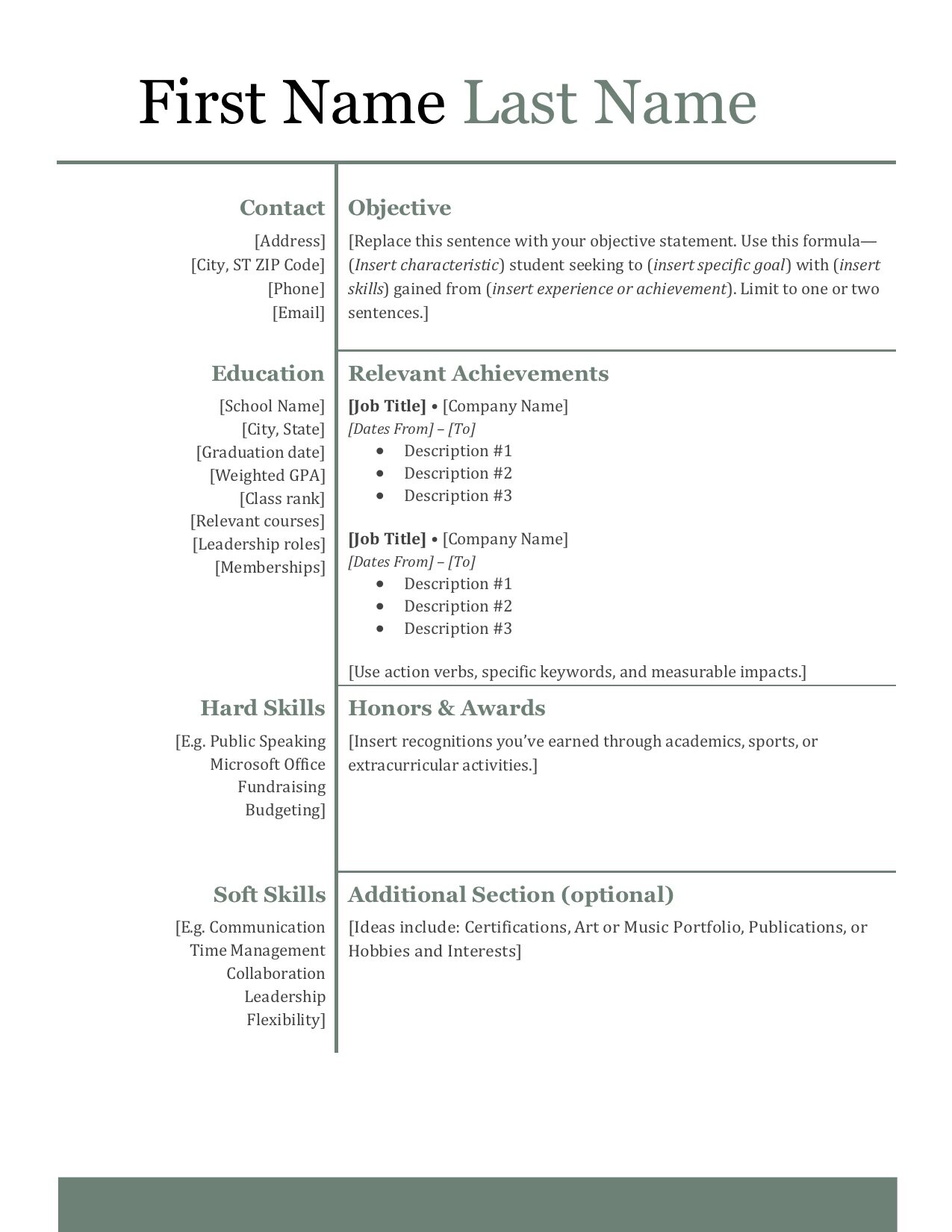
High school resume template
----
Frequently asked questions
Do all colleges require a high school resume?
No — most colleges do not require a separate resume as part of the application. However, many scholarship programs, honors programs, summer opportunities, and college interviews do request one. It's also a useful document to have when asking teachers or counselors for letters of recommendation, as it gives them a complete picture of your achievements.
Should I tailor my resume for each application?
Yes — especially for job and internship applications. Review the job description carefully and use similar language to describe your relevant skills and experiences. For college applications, align your language with the school's stated values and mission. A resume that feels written specifically for the reader is always more effective than a generic one.
How often should I update my resume?
After every significant new experience, achievement, or skill. A good habit is to review and update your resume at the start of each school year and again before any major application deadline. Keeping it current means you're never scrambling to remember details when a deadline hits.
What's the difference between a resume for a job and a resume for college?
The structure is similar, but the emphasis differs. A job resume should highlight relevant work experience, hard skills, and measurable results. A college resume can be broader — including academic achievements, extracurriculars, volunteer work, and personal interests — because colleges are evaluating you as a whole person, not just as a potential employee.
Final thoughts
Your high school resume will evolve over time as you gain new experiences, qualifications, and skills. But you have to start somewhere, and now’s the time to begin. We’ve provided all the information, tools, and ideas you need to create a high quality, professional-looking high school resume. With a resume like this in your pocket, many promising career and educational doors will open for you.

About the Author
Dr. Shirag Shemmassian is the Founder of Shemmassian Academic Consulting and one of the world's foremost experts on college admissions. For over 20 years, he and his team have helped thousands of students get into top programs like Harvard, Stanford, and MIT using his exclusive approach.
Want to know exactly what it takes to get into America's most selective colleges?
Get our free 110-page guide we use to help our students routinely get admitted to schools like Harvard, Yale, and Stanford: How to Get into America's Elite Colleges: The Ultimate Guide